
What Is the Real Cost of Not Switching HOA Software?

Switching HOA software involves migration, training, and implementation risk. But staying with an outdated platform can create its own costs through manual work, additional staffing, disconnected data, limited financial visibility, and reduced capacity to scale. Management companies should evaluate both sides of that equation before deciding whether to stay or switch.

What Is the Real Cost of Not Switching HOA Software?

Why growing HOA management companies should evaluate the operational and financial risk of staying with technology they’ve outgrown.

If your portfolio doubled tomorrow, what would break first?

Would accounting need more people?

Would managers need more administrative support?

Would reporting become harder?

Would onboarding slow down?

Would leadership lose visibility across the portfolio?

Would the number of spreadsheets, manual processes, and workarounds increase?

Your team probably already knows the pressure points.

It’s the spreadsheet someone created three years ago that somehow became part of the accounting process.

It’s the report that still needs to be exported and rebuilt before leadership sees it.

It’s the manager who knows which three systems to check before answering a board member’s question.

It’s the employee everyone asks because they’re the only person who knows how a particular process actually works.

None of these things looks like a major technology problem on its own.

Together, they tell a different story.

As an HOA management company grows, inefficient technology rarely fails all at once. Instead, the organization quietly compensates for it.

The software still technically works.

But the business is working harder because of it.

Eventually, the question is no longer:

Does our HOA software work?

The better question is:

Can our technology support where we intend to take this company?

The Cost of Staying Doesn’t Appear on an Invoice

The cost of switching HOA software is relatively easy to see.

Implementation has a price. Training requires time. Migration appears on a project calendar. Leadership can see the disruption and estimate the resources involved.

The cost of staying is much harder to see.

It often appears in five-minute chunks.

Five minutes entering information into another system.

Ten minutes manipulating a report in Excel.

Twenty minutes tracking down information that lives somewhere else.

Another manual reconciliation.

Another workaround.

Another employee needed as the portfolio grows.

One workaround may seem insignificant.

Multiply those workarounds across employees, departments, communities, and an entire year, and they become something very different.

They become part of the company’s operating model.

And as the organization grows, so does the cost.

The Growth Tax of Legacy HOA Software

We call this the Growth Tax: the additional labor, complexity, and operational overhead an organization absorbs when its technology cannot scale at the same rate as its portfolio.

Growth should create leverage.

But when technology cannot support the organization as it expands, growth can create more administrative work instead.

Leadership may begin seeing the symptoms:

  • Headcount increasing simply to maintain existing workloads
  • Managers reaching capacity sooner
  • Accounting teams spending more time reconciling than analyzing
  • Longer onboarding cycles for new employees
  • Different teams developing different processes
  • Increasing dependence on spreadsheets and outside systems
  • Limited visibility across the portfolio
  • Slower response times as volume increases
  • More difficulty absorbing new communities or acquisitions

At that point, software is no longer simply an IT or operational decision.

It becomes a business scalability decision.

A management company adding communities should not automatically have to add administrative complexity at the same rate.

Technology should create capacity.

What Could the Growth Tax Actually Cost?

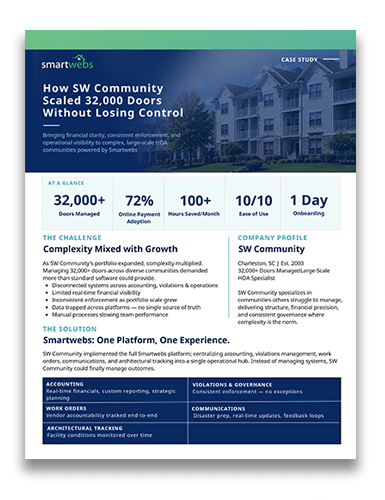
Operational friction rarely appears as a single line item. How SW Community Scaled 32,000 Doors Without Losing Control
Consider a simple hypothetical example.

Imagine 20 employees each spend an average of 30 minutes per day on avoidable administrative work such as duplicate data entry, searching across systems, manipulating spreadsheets, or moving information between disconnected platforms.

That equals:

20 employees × 0.5 hours × 5 days × 50 weeks = 2,500 hours per year.

At an illustrative loaded labor cost of $40 per hour, that represents:

$100,000 in annual labor capacity.

That is not a Smartwebs customer result. It is simply an example of how small amounts of operational friction can compound across an organization.

But this problem isn’t only theoretical.

SW Community manages more than 32,000 doors using Smartwebs and reports saving 100+ hours every month. The company also reports 72% online payment adoption, a 10/10 ease-of-use rating, and one-day onboarding.

That’s more than 1,200 hours of reported operational capacity over the course of a year.

Read the SW Community case study

The larger point isn’t simply that technology can save time.

Efficiency saves time. Capacity creates room to grow.

Growth and Scale Are Not the Same Thing

An important difference exists between growing an HOA management company and scaling one.

Growth can mean adding communities, employees, revenue, and workload simultaneously.

Scaling means increasing the business without increasing resources and complexity at exactly the same rate.

That is where technology becomes strategic.

If every additional group of communities requires another set of spreadsheets, manual processes, reporting work, or administrative headcount, leadership should understand why.

The problem may not be the people.

It may be the operating system they have been given.

The executive question becomes:

Can our technology help us manage more communities without multiplying the work required to manage them?

That is a very different standard than asking whether software has accounting, violations, architectural review, communications, work orders, or reporting.

Most modern HOA platforms offer features.

The more important question is how well those capabilities work together.

Start With the Workarounds

One of the simplest ways to evaluate your current HOA software is to stop looking at its feature list.

Look at everything your employees have built around it.

How many spreadsheets are necessary to complete routine processes?

Where is information entered more than once?

Which reports must be exported and manipulated manually?

What information lives in email because the software doesn’t provide a practical place for it?

How many systems does a manager open during a normal day?

How many people need to become involved simply to answer a leadership question?

How often does accounting reconcile information that should already agree?

These workarounds reveal something feature comparisons often miss:

The actual cost of getting the work done.

They also provide leadership with a better framework for evaluating a new platform.

The goal should not simply be to reproduce the same processes in different software.

The goal should be to eliminate the reasons those workarounds existed in the first place.

Five Questions Leadership Should Ask Before Deciding to Stay

1. Are we adding people because we’re growing, or because our processes don’t scale?

Those are not the same kind of headcount.

Growth naturally requires talented people. But if we add employees mainly to do repetitive administrative work, reconcile disconnected information, build reports, or compensate for inefficient processes, technology may be driving the staffing need.

2. How much work happens outside our primary platform?

Spreadsheets, disconnected applications, manual reporting, duplicate entry, and email-based processes can all indicate operational friction.

The more work happens outside the primary system, the harder it becomes to maintain consistent processes and reliable information as the organization grows.

3. Can leadership see the business without asking someone to assemble the answer?

Executives need visibility.

Portfolio performance, financial information, operational activity, community trends, and exceptions should not require a scavenger hunt through systems and spreadsheets.

Leadership shouldn’t have to ask five people to find one number.

4. Could our current operating model support twice our portfolio?

Imagine twice the communities.

Twice the homeowner interactions.

More accounting activity.

More ARC requests.

More violations.

More work orders.

More communications.

More documents.

Would your current technology absorb that additional volume?

Or would your organization have to absorb it with more people and more processes?

5. What are we actually protecting by avoiding migration?

Avoiding disruption can feel like the safest choice.

But maintaining the status quo is still a business decision.

Leadership should compare the temporary risk and effort of implementation against the cumulative cost of operating inefficiently for another three, five, or ten years.

Migration Risk Is Real. It Should Also Be Manageable.

None of this means management companies should underestimate software migration.

Community management organizations may hold years of homeowner information, financial history, association documents, violations, architectural records, communications, vendor information, and operational data.

Moving that information deserves careful planning.

Before selecting a new platform, leadership should understand:

  • What information can be migrated?
  • How will the data be prepared?
  • Who is responsible for validation?
  • What historical information will remain accessible?
  • What information should be cleaned before migration?
  • What systems can be integrated?
  • What resources are required internally?
  • How will employees be trained?
  • What happens before, during, and after go-live?

A strong implementation conversation addresses these questions early, not after a contract has been signed.

Migration Doesn’t Have to Mean Starting Over

Community Financials provides a useful real-world example.  2026 Community Financials Case Study (9-15-2026)
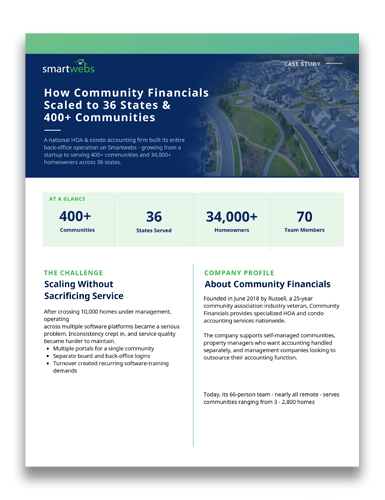
The national HOA and condominium accounting firm adopted Smartwebs in September 2022. Since then, it has migrated its entire customer base onto Smartwebs, including customers previously operating in Tops/Enumerate and Caliber/Frontsteps environments.

Today, Community Financials operates across approximately 400+ communities, 34,000 homeowners, and 36 states on Smartwebs.

That matters because migration and growth didn’t have to be opposing objectives.

The company continued expanding its national operation while consolidating its technology environment.

Founder and CEO Russell describes the relationship with Smartwebs as a partnership, highlighting the company’s willingness to listen to his experienced accounting team and evolve the platform based on their input.

Read the Community Financials case study

For leadership teams evaluating a switch, the lesson isn’t that every migration will look the same.

It’s that migration capability should itself be part of the software evaluation.

Financial Integrity Is Non-Negotiable

Accounting deserves particular attention during any HOA software conversion.

A migration plan should clearly address financial information such as:

  • General Ledger balances
  • Owner account balances
  • Assessment and charge structures
  • Open receivables
  • Credits and prepaid balances
  • Bank information
  • Historical transactions
  • Financial reports
  • Audit trails

Before go-live, imported financial information should be validated against appropriate legacy reports.

Depending on the organization’s accounting structure, that may include Trial Balance reports, Accounts Receivable Aging reports, owner prepaid summaries, opening balances, and other records used by the accounting team.

But financial migration is not simply an accounting concern.

Financial discrepancies can affect homeowner trust, board confidence, reporting, audit readiness, and the management company’s reputation.

That makes financial integrity a business continuity requirement, not merely a data-transfer task.

The objective isn’t simply to move financial information.

It is to establish confidence that the organization begins operating in the new environment with accurate information.

Historical Data Still Matters

Changing HOA software should not mean abandoning the institutional history of the communities you manage.

Management companies should understand how a prospective platform handles historical information, including:

  • Owner ledger history
  • General Ledger transactions
  • Architectural review records
  • Violation histories
  • Association documents
  • Owner communications
  • Community files

Historical information can remain important for operations, financial reporting, audits, homeowner questions, board requests, and future decision-making.

Ask what will move, what will remain accessible, and how employees will find it after implementation.

Don’t Just Migrate Data. Rethink the Work.

A successful software conversion should not simply recreate every old process inside a new platform.

That misses the opportunity.

If employees currently enter information twice, why?

If managers maintain separate spreadsheets, what problem are those spreadsheets solving?

If accounting has developed manual reconciliation processes, what created the need?

If leadership cannot easily see portfolio performance, where is that information trapped?

Migration creates an opportunity to ask a much more valuable question:

If we were designing this operation today, would we design it this way?

Often, the answer is no.

That is why implementation should involve the people who actually perform the work.

They know where the extra steps are.

They know which reports require manipulation.

They know where information gets lost.

They know which “temporary” spreadsheets became permanent years ago.

Those insights can help transform implementation from a software project into an operational improvement initiative.

Technology Should Create Capacity

The objective of modern HOA technology should not simply be digitization.

It should be capacity.

Managers should have more capacity to manage communities and relationships.

Accounting teams should have more capacity to analyze financial information instead of manually assembling it.

Leadership should have greater visibility without creating additional reporting work.

Employees should spend less time finding information and more time acting on it.

And as the portfolio grows, technology should help absorb increasing complexity rather than contribute to it.

That is where connected systems matter.

When accounting, community operations, communications, reporting, workflows, documents, automation, and intelligence operate in a connected environment, information can move with the work instead of employees constantly moving information between systems.

What Does Scalability Look Like in Practice?

Technology claims are easy to make.

Customer outcomes are more meaningful.

SW Community’s experience provides one example.

As its portfolio grew to more than 32,000 doors, disconnected accounting, violations, and operational systems created increasing complexity. Smartwebs brought accounting, violations management, work orders, communications, and architectural tracking into one operational environment.

Today, SW Community reports:

32,000+ doors managed

100+ hours saved each month

72% online payment adoption

10/10 ease of use

One-day onboarding

Owner and President Steven Wagner describes Smartwebs not simply as software, but as the foundation that enables the company to bring financials, compliance, and operations together while continuing to scale.

Community Financials offers another perspective on scale.

Its back-office operation now supports approximately 400+ communities and 34,000 homeowners across 36 states on Smartwebs.

Different organizations. Different operating models.

But the same larger question:

Can the technology support increasing complexity without becoming the source of it?

That is the standard executives should be evaluating.

The Bigger Risk Isn’t Always the Change

Every software transition carries risk.

But staying is also a decision.

And it carries a cost.

If your organization is compensating for its technology with additional people, spreadsheets, manual reconciliation, disconnected systems, and increasingly complicated processes, those costs don’t disappear because they’re difficult to see on a budget line.

They compound as the portfolio grows.

The risk equation therefore has two sides.

There is the short-term risk of change.

And there is the long-term risk of continuing to operate around technology the organization has already outgrown.

So perhaps the most useful question isn’t:

“How difficult will it be to switch HOA software?”

It is:

“What will our current operating model cost us if we don’t?”

Don’t Just Compare Software. Compare the Business You Can Build With It.

The right HOA platform should do more than replace existing software.

It should help remove the operational limitations that made leadership consider replacing it in the first place.

Before switching HOA software, document the workarounds.

Understand the financial requirements.

Evaluate your data.

Talk to the employees performing the work.

Determine what needs to become easier.

Then look further ahead.

Ask what your organization should look like at twice its current size.

Ask what information leadership needs to make decisions.

Ask where technology could create capacity instead of consuming it.

Ask which processes should disappear rather than simply move.

Then evaluate software against that standard.

At Smartwebs, we bring community operations, accounting, workflows, communications, reporting, automation, and AI into one connected environment designed for community association management.

One Platform. One Login. One Unified Experience.

What Would Your Operation Look Like Without the Workarounds?

Bring us the processes your team has built around your current software: the spreadsheets, manual reconciliations, duplicate entry, disconnected workflows, and reporting challenges.

We’ll show you how those same processes can work in one connected Smartwebs environment.

See Smartwebs in action.

Request a demo. →

Frequently Asked Questions About Switching HOA Software

How difficult is it to switch HOA management software?

The complexity depends on portfolio size, data quality, accounting requirements, integrations, workflows, historical information, and available internal resources. A strong implementation plan should define those requirements before migration begins and establish clear responsibilities for data preparation, validation, training, and go-live.

What should a CEO consider before switching HOA software?

Leadership should evaluate more than features. Consider operational efficiency, staffing requirements, financial controls, portfolio visibility, scalability, migration risk, implementation resources, and whether the current platform can support future growth without creating proportionally more administrative work.

Can existing HOA data be moved to new software?

Often, yes, although the amount and type of information that can be migrated varies by platform and source system. Management companies should ask specifically about homeowner records, financial history, documents, violations, architectural records, communications, association information, and other historical data important to operations.

What happens to accounting records when changing HOA software?

Accounting migration should be carefully planned and validated. Management companies should determine which balances, transactions, bank information, owner records, historical financial information, and reports will move and how imported information will be reconciled against the legacy system before go-live.

How long does HOA software implementation take?

There is no universal implementation timeline. Portfolio size, data complexity, accounting configuration, integrations, training requirements, migration scope, and available internal resources can all affect the schedule. Ask for an implementation plan based on your actual operation rather than relying on a generic estimate.

How can management companies prepare employees for new HOA software?

Focus on workflows rather than simply teaching employees where features are located. Identify existing workarounds, involve employees who understand current processes, provide role-specific training, and demonstrate which manual steps the new platform is intended to eliminate.

When should a management company consider changing HOA software?

Common indicators include duplicate data entry, excessive manual processes, disconnected systems, heavy spreadsheet use, limited reporting, difficulty accessing portfolio-level information, increasing administrative headcount, and technology that makes growth increasingly difficult to manage.

How should management companies compare HOA software?

Feature comparisons are useful, but leadership should also compare workflows, accounting capabilities, integrations, migration support, reporting, automation, implementation resources, scalability, and documented customer outcomes.

The larger question isn’t simply which platform has the longest feature list.

It is which platform best supports the operating model the organization is trying to build.


More Great Articles!

Does Your HOA Management Software Really Include Accounting?

Does Your HOA Management Software Really Include Accounting?

HOA management software with accounting sounds straightforward.

Your platform manages communities. It also handles the books. Everything should work together.

But does it?

As more HOA software providers describe themselves as “all in one,” accounting deserves a closer look. Having an accounting option on a feature list does not necessarily mean financial management is truly connected to the rest of your operation.

For management companies, that distinction matters.

What Does HOA Management Software With Accounting Actually Mean?

Different platforms approach accounting in different ways.

Some have accounting built directly into the platform. Others connect with a separate accounting product or rely on partner integrations. Some provide basic financial functions but require another system for more complex accounting.

None of those approaches should automatically determine whether software is right or wrong for your company.

The important question is simpler:

How much work does your team have to do to make everything work together?

If financial information lives in one place while community operations live somewhere else, employees may still be switching systems, reconciling information, exporting data, or building reports manually.

That’s where a feature can become another workflow to manage.

HOA Accounting Is More Than a General Ledger

Community association accounting has requirements that are different from many other businesses.

Management companies may need to manage separate community financials, assessments, owner balances, accounts payable, bank reconciliations, budgets, financial statements, delinquency activity, and board reporting across dozens or hundreds of associations.

That means HOA accounting software shouldn’t simply record transactions.

It should support the way community associations actually operate.

And for a management company, it needs to do that at scale.

The Bigger Question Is What Connects to Accounting

This is where the conversation gets more interesting.

Imagine a manager needs to answer a board member’s financial question.

Can they see the information they need without requesting a separate report from accounting?

What happens when a homeowner’s account activity affects another workflow?

Can leadership see financial and operational information across its portfolio?

Can community activity provide context for financial reporting?

When accounting is part of the same operational environment, information has the potential to move with the work.

The goal isn’t simply accounting inside HOA software. It’s accounting connected to HOA operations.

Native Accounting vs. Integrated Accounting

This is a question worth asking every software provider.

Is your accounting native to the platform, or does it depend on another product?

Integrations can be useful. However, management companies should understand what happens behind the scenes.

Ask whether information syncs in real time. Find out whether employees move between interfaces. Ask where the source of truth lives and what happens if an integration fails.

Most importantly, ask your accounting team how many manual steps remain.

A software diagram can look beautifully connected.

Your employees’ daily workflow tells you whether it really is.

AI Is Changing the Accounting Conversation

Artificial intelligence introduces another reason connected financial information matters.

AI can help financial teams identify anomalies, recognize trends, summarize complex information, and surface activity that may need attention.

But useful financial AI needs context.

A standalone AI tool may understand a set of numbers. AI working within a connected HOA platform has the potential to understand those numbers alongside the community and operational information surrounding them.

That’s an important difference.

Smartwebs is developing SAMi Financial around this idea. The goal is to use intelligence to support processes such as reconciliation, anomaly detection, financial analysis, and clearer financial insights.

AI shouldn’t replace financial professionals.

It should help them find what deserves their attention faster.

What Should You Ask an HOA Software Provider About Accounting?

Don’t simply ask:

“Do you have accounting?”

Ask:

  • Is accounting native to your platform?
  • Which accounting functions require another product?
  • Will our teams work from the same information?
  • How many times will information need to be entered?
  • Can accounting and operations share data?
  • Can we report across multiple communities?
  • How are bank reconciliations handled?
  • How does the platform support association-level financial reporting?
  • Where is AI being used in financial workflows?
  • What still requires manual work?

Those answers reveal much more than a checkmark beside Accounting on a comparison sheet.

Accounting Shouldn’t Feel Like Another System

The point of HOA management software with accounting shouldn’t be having two major systems accessible through one login.

It should be reducing the distance between financial management and community operations.

At Smartwebs, we bring accounting into the same environment as the work happening throughout community management. SAMi Financial takes that further by bringing intelligence into financial processes and analysis.

That’s the larger idea behind:

One Platform. One Login. One Unified Experience.

Because if accounting is part of your HOA management platform, it should feel like it.

Look Beyond the Accounting Checkbox

When you’re evaluating HOA software, don’t stop at whether Accounting appears on the feature list.

Follow the financial workflow.

See where the information lives. See how many systems your team touches. See what requires manual intervention. And see whether financial information is truly part of the larger operational picture.

That’s where the difference between having accounting and having connected accounting becomes clear.

See how Smartwebs brings accounting and community operations together.

Request a Smartwebs demo. →


Frequently Asked Questions About All-in-One HOA Software

What is HOA accounting software?

HOA accounting software helps community associations and management companies manage financial activities such as assessments, owner balances, accounts payable, bank reconciliations, budgeting, financial statements, and reporting.

Does HOA management software include accounting?

Some HOA management platforms include native accounting capabilities, while others use third-party software or integrations. Buyers should determine which functions are built into the platform and how financial information connects with community operations.

What is the difference between HOA accounting software and general accounting software?

General accounting software is designed for businesses across many industries. HOA accounting software is designed around community association needs, which may include association-level financials, homeowner assessments, owner ledgers, budgets, bank accounts, delinquencies, and board reporting.

Is native HOA accounting better than an integration?

Not automatically. The better solution depends on the management company’s needs. However, buyers should evaluate data synchronization, duplicate entry, reporting, workflow continuity, reliability, and how often employees must move between systems.

Why should HOA accounting connect with operations?

Connected financial and operational information can reduce duplicate work and give managers, accounting teams, and leadership more context. It can also improve reporting and create a stronger information foundation for automation and AI.

How can AI help HOA accounting teams?

AI can help analyze financial information, identify unusual activity, surface patterns, assist with reconciliation, and make complex information easier to understand. Human financial oversight remains important, particularly for decisions and exceptions.


More Great Articles!

What Does “All-in-One” HOA Software Actually Mean?

What Does “All-in-One” HOA Software Actually Mean?

All-in-one HOA software is everywhere.

Nearly every platform promises more features, better integrations, and fewer systems to manage. On paper, many of them can look remarkably similar.

But there is a big difference between having everything on a feature list and having everything work together.

For community management companies, that difference can affect how much time employees spend switching systems, entering information twice, tracking down answers, and manually moving work forward.

So, when a software provider says “all-in-one,” what should you actually expect?

Does All-in-One Really Mean One Platform?

Not always.

Software providers build their platforms in different ways. Some capabilities may be native. Others may come from third-party integrations, partner products, or acquired technology.

Integrations aren’t necessarily a problem. In fact, the right integration can add significant value.

The real question is what happens to the workflow.

Does an employee have to leave one system to finish a task in another? Does information move automatically? Does someone have to enter the same data twice?

If your employees are responsible for connecting the systems, the technology may be integrated. However, the experience isn’t necessarily unified.

Look Beyond the Feature Checklist

Imagine two HOA software platforms.

Both list accounting, violations, ARC, communications, documents, reporting, and resident portals.

On a comparison sheet, they appear almost identical.

Now imagine completing an architectural request.

In one system, the request enters a connected workflow. Documents, communication, approvals, status updates, and records stay with the request.

In the other, employees move between applications, transfer information, send emails, and manually update the status.

Same features.

Very different experience.

That’s why evaluating all-in-one HOA software requires looking beyond what a platform has and examining how the work actually gets done.

Ask: How Does the Work Move?

Consider a community drive.

A manager identifies a violation and takes a photo.

What happens next?

Do they return to the office, find the property in another system, upload the image, enter the information, create the violation, and start the next step?

Or can the activity move directly into a workflow?

Now apply that question elsewhere.

What happens when an ARC request needs approval? When a resident asks a question? When a board member needs financial information? When leadership wants a portfolio-wide report?

The real value of all-in-one HOA software isn’t the number of features on a checklist. It’s how little effort it takes to move the work forward.

One Login Isn’t Necessarily One Experience

Single sign-on is convenient. But one login alone doesn’t create a unified platform.

Employees can still log in once and find themselves navigating several disconnected interfaces.

A unified experience should go further.

Accounting should connect with operations. Communications should connect with the activity they concern. Field work should connect with office workflows. Reporting should provide visibility across the organization.

The technology behind that experience may be complex.

Using it shouldn’t be.

AI Raises the Stakes

Artificial intelligence makes connected information even more important.

AI can help teams find information, analyze financial activity, identify patterns, streamline fieldwork, and support workflows.

However, AI needs context.

If important information is scattered across separate systems, spreadsheets, inboxes, and documents, AI may have only part of the picture.

Connected data gives AI more context to work with.

For example, financial information can have operational context. Field activity can connect with a workflow. Community information can be connected to historical records.

As a result, the conversation about all-in-one HOA software is becoming bigger than the conversation about software consolidation.

It’s also about creating the foundation for more useful intelligence.

What Should You Ask Before Choosing All-in-One HOA Software?

Don’t stop at, “Does your platform have this feature?”

Ask how it works.

Start with these questions:

  • Which capabilities are native to the platform?
  • Which capabilities depend on third-party integrations?
  • Will our employees need to move between different interfaces?
  • Does information flow automatically between workflows?
  • Where will employees still need to enter information manually?
  • Can financial and operational information work together?
  • Can leadership report across the organization?
  • Can AI work with information across the platform?
  • What happens when one integrated product is updated or unavailable?

These questions reveal something a feature comparison often cannot:

What will it actually be like to use the software every day?

All-in-One Should Feel Like One Experience

Community management companies don’t need more software simply for the sake of having more technology.

They need technology that makes the work easier.

At Smartwebs, that means bringing accounting, ARC, violations, communications, documents, reporting, resident and board experiences, mobile workflows, automation, and AI into a connected environment.

The goal is simple: reduce the effort required to move from one part of the job to the next.

That’s what we mean by:

One Platform. One Unified Experience.

See What All-in-One Looks Like in Practice

The best way to evaluate an all-in-one platform isn’t by counting features.

See how the work moves.

See how information connects.

And see how much your team can accomplish without leaving the platform.

See how Smartwebs brings community management together in one connected experience.

  Schedule a Smartwebs Walkthrough →


Frequently Asked Questions About All-in-One HOA Software

What is all-in-one HOA software?

All-in-one HOA software brings multiple community management functions into one technology environment. These can include accounting, violations, ARC, communications, resident and board portals, documents, reporting, work orders, mobile tools, and automation.

Is all-in-one HOA software the same as integrated HOA software?

Not necessarily. Integrated HOA software can connect separate applications or systems. An all-in-one platform may offer more capabilities in a single environment. Buyers should evaluate how information, workflows, and user experiences actually connect rather than relying on either label alone.

Are third-party integrations bad for HOA management software?

No. Third-party integrations can add valuable specialized capabilities. The important question is whether an integration creates extra work. Management companies should understand when employees need to switch systems, re-enter information, or manage separate workflows.

What should an HOA management company look for in an all-in-one platform?

Look beyond individual features. Evaluate how information moves between accounting, operations, communications, field activities, reporting, and resident services. Also consider the number of interfaces employees use, the potential for duplicate data entry, automation, reporting capabilities, and how well the platform scales.

Can all-in-one HOA software reduce manual work?

It can when workflows and information are genuinely connected. For example, a connected platform may reduce duplicate data entry, system switching, manual status updates, and the need to transfer information between departments or applications.

Why does connected HOA software matter for AI?

AI works best when it has relevant information and context. When financial, operational, community, and workflow information is connected, AI can potentially provide more useful analysis, insights, and workflow support than when information is fragmented across unrelated systems.


More Great Articles!

AI Is Changing HOA Management. What Does That Actually Mean?

AI Is Changing HOA Management. What Does That Actually Mean?

AI for HOA management is quickly moving from an industry talking point to something community management companies are actively evaluating.

Software companies are adding AI assistants. New tools promise automation. Managers are experimenting with generative AI. Leadership teams are asking where artificial intelligence fits into their technology strategy.

But there’s an important question underneath all of that activity:

What does AI actually change about managing a community?

The answer shouldn’t simply be that software now has an AI button.

The real opportunity is using artificial intelligence to reduce repetitive work, make information easier to understand, recognize patterns, and help community management professionals act on the information already moving through their organizations.

That’s where AI becomes more than a feature.

It becomes part of the work.

How Is AI Being Used in HOA Management?

AI for HOA management can support tasks involving financial analysis, governing documents, field operations, workflow automation, information retrieval, reporting, and operational decision-making.

The most valuable applications tend to have something in common: they address work community management teams already perform.

That’s an important distinction.

Community managers don’t need AI simply because it’s new. They need technology that reduces administrative friction and helps them work more effectively.

For AI to accomplish that, it needs to understand the information and context surrounding the task.

AI Can Make HOA Information Easier to Find

Community management organizations generate and maintain an enormous amount of information.

Governing documents. CC&Rs. Policies. Meeting records. Financial information. Owner records. Architectural requests. Violation histories. Community documents.

Finding the right answer can require searching through multiple documents or asking someone else where the information lives.

AI can change that experience.

Instead of relying entirely on traditional search methods, natural-language AI can allow users to ask questions about information and receive relevant answers much more quickly.

Imagine asking:

What does this community’s governing document say about short-term rentals?

Or:

What are the architectural requirements for exterior paint?

The value isn’t simply that AI generated an answer. The value is reducing the time between a question and the information needed to respond.

This is part of the thinking behind SAMi Insights, which applies AI to community information and governing documents, enabling teams to more easily find and understand the information they need.

AI Can Help Financial Teams See What Needs Attention

HOA accounting involves much more than producing financial statements.

Accounting teams manage reconciliations, assessments, payables, owner balances, budgets, cash flow, reporting, and exceptions that can require investigation.

Traditional accounting systems are very good at recording transactions.

AI offers the potential to help teams understand what those transactions are telling them.

AI for HOA management can potentially help identify unusual financial activity, surface anomalies, summarize financial information, recognize trends, and make complex data easier to interpret.

That doesn’t replace accountants or financial expertise.

It can help professionals focus their expertise where it matters most.

Smartwebs is applying this idea through SAMi HOA Financial, where AI can support financial analysis, reconciliation, anomaly detection, cash-flow understanding, and plain-language financial insights.

The goal is not automated decision-making without oversight.

It’s better visibility into the information financial teams already manage.

AI Can Change What Happens During Community Drives

Some of the most time-consuming work in community management happens outside the office.

A manager conducting a community drive may identify violations, take photographs, record notes, verify addresses, categorize issues, and then return to the office to organize everything collected in the field.

The drive itself may only be part of the work.

Processing the drive can become an entirely different job.

This is where AI can have a very practical impact.

Rather than asking a manager to collect information and manually recreate it later, AI can help analyze what was captured and route it to the appropriate workflow.

Smartwebs’ SAMi HOA Drive is being built around that idea:

Drives recorded. AI analyzed. Done.

That phrase matters because it describes the outcome rather than the technology.

The best AI doesn’t necessarily create another task for someone to perform.

It removes steps from a task they’re already doing.

AI Can Help Workflows Move Forward

Community management is full of processes.

A violation progresses through stages.

An architectural request moves through the review and approval process.

A work order moves from request to assignment to completion.

Financial processes follow established steps.

Resident questions need responses, documentation, and sometimes escalation.

Many of these activities involve predictable actions that don’t necessarily require someone to manually initiate every step.

That’s where AI for HOA management and workflow automation can work together.

AI can help interpret information or recognize what is happening. Automation can then help route work, trigger actions, generate reminders, update statuses, or surface exceptions that require human attention.

The distinction is important.

Automation follows rules.

AI can help interpret information and context.

Used together, they can create workflows that require less manual intervention while keeping people involved where judgment is needed.

AI Assistant or AI Agent: What’s the Difference?

As AI terminology evolves, community management leaders will hear more about assistants, copilots, agents, and agentic AI.

The differences matter.

An AI assistant generally responds when someone asks it to do something. A user asks a question, requests information, or initiates an action.

An AI agent can potentially take a more active role. Depending on how it is designed and governed, an agent may evaluate information, determine the appropriate action, perform steps within a workflow, and escalate exceptions when human involvement is required.

Think about the difference between:

“Show me the violations that need follow-up.”

and:

“Identify violations that have reached the follow-up stage, prepare the appropriate next action, and flag anything unusual for review.”

The first is assistance.

The second begins to move toward agentic work.

For HOA management, this evolution could be significant because much of the industry involves repeatable workflows alongside situations that still require human judgment.

Will AI Replace Community Managers?

AI is much better suited to changing parts of a community manager’s workload than replacing the community manager.

Community management involves relationships, negotiation, leadership, empathy, judgment, conflict resolution, local knowledge, board dynamics, and decisions where context matters.

Those responsibilities are deeply human.

The administrative burden surrounding them doesn’t always need to be.

Managers spend time searching for information, organizing documentation, transferring data, reviewing repetitive tasks, preparing reports, and advancing routine processes.

AI can help reduce some of that work.

That creates an important distinction:

The goal shouldn’t be fewer community managers. It should be fewer unnecessary tasks consuming a community manager’s day.

The organizations that understand that difference are likely to get much more value from AI.

AI Is Only as Useful as the Information Behind It

There’s another issue that often gets overlooked in conversations about artificial intelligence.

AI needs information.

If a management company’s information is fragmented across unrelated applications, spreadsheets, email inboxes, local files, and disconnected databases, AI has a fragmented view of the organization.

That limits what it can understand and do.

This is why AI for HOA management is closely connected to the larger conversation about platform architecture.

A connected technology environment gives AI more context.

Financial activity can have operational context. Community information can have historical context. Field activity can connect with workflows. Reporting can draw from a broader picture of what’s happening across the organization.

The stronger the technology foundation, the more useful intelligence can become.

What Should Management Companies Ask About HOA AI?

As more vendors introduce AI capabilities, management companies should look beyond whether a product has “AI” on its feature list.

Ask what the AI actually does.

Does it solve a real operational problem?

What information does it use?

Is that information connected to the rest of the platform?

Does it reduce the number of steps in an existing workflow?

Can employees understand why an insight or recommendation was produced?

Where does human review still play a role in the process?

How is community and financial information protected?

Is AI helping employees accomplish work, or simply giving them another interface to manage?

Those questions are more important than the AI label itself.

From AI Features to Intelligent Community Management

The first generation of business AI largely focused on generating content and answering questions.

That’s useful, but it’s only the beginning.

The greater opportunity for HOA management lies in connecting intelligence to actual operations.

Imagine AI that can help understand a governing document, recognize a financial exception, analyze information collected during a property drive, identify a workflow requiring attention, or help leadership recognize patterns across communities.

Those aren’t isolated AI tricks.

They’re examples of intelligence becoming part of the operating environment.

That’s the direction community management technology is moving.

What Does Smartwebs Mean by AI for HOA Management?

At Smartwebs, we’re approaching AI in the context of the work community management professionals already perform.

SAMi HOA Ask focuses on making community information and governing documents easier to access and understand.

SAMi HOA Financial brings intelligence into financial processes and analysis.

SAMi HOA Drive applies AI to field operations and community drives.

These capabilities address different aspects of community management, but the underlying strategy is connected.

AI shouldn’t sit beside the platform as another disconnected tool.

It should become intelligence within the platform.

That distinction becomes increasingly important as AI evolves from answering questions toward helping work move forward.

The Future Isn’t AI Beside the Platform

Community management companies don’t need another piece of technology competing for their attention.

They need technology that understands the work.

That’s why the future of AI for HOA management isn’t simply a chatbot added to existing software.

It’s intelligence connected to financial information, governing documents, field operations, workflows, reporting, and the people responsible for managing communities.

AI will continue to evolve quickly.

But the measure of progress shouldn’t be how much AI a platform can advertise.

It should be how much unnecessary work the technology can remove while helping people make better, faster, more informed decisions.

That’s where Smartwebs is headed.

One Platform. One Unified Experience.

And increasingly, intelligence throughout that experience.

See AI for HOA Management in Action

Discover how Smartwebs is bringing AI into community management operations through SAMi HOA Ask, SAMi HOA Financial, SAMi HOA Drive, and one connected platform.

  Schedule a Smartwebs Walkthrough →

Frequently Asked Questions About AI for HOA Management

How is AI used in HOA management?

AI can help HOA management teams retrieve information from governing documents, analyze financial activity, identify patterns, streamline field operations, summarize information, support workflows, and reduce repetitive administrative work.

Can AI help with HOA accounting?

Yes. AI can support HOA accounting by helping identify anomalies, analyze financial activity, summarize financial information, recognize trends, and assist with processes such as reconciliation. Financial professionals should remain involved in reviewing and interpreting important financial decisions.

Can AI read HOA governing documents?

AI can be used to search and interpret information contained in governing documents such as CC&Rs, policies, and other community records. The quality of the answer depends on the underlying documents, the AI system, and the context available to it.

Can AI automate HOA violations?

AI can assist parts of the violation process, particularly information analysis, categorization, documentation, and workflow support. Automation can then help move routine steps forward while keeping managers involved in situations requiring review or judgment.

Will AI replace HOA community managers?

AI is more likely to change the administrative workload of community managers than replace the role itself. Community management depends heavily on relationships, judgment, communication, leadership, and local context. AI is best suited to reducing repetitive work and helping managers access and understand information more efficiently.

What should an HOA management company look for in AI software?

Management companies should evaluate whether AI addresses real operational problems, uses relevant, connected information, reduces manual steps, includes appropriate human oversight, protects community data, and integrates with the organization’s existing workflows.


More Great Articles!

The Modern HOA Technology Stack: What Community Management Companies Need in 2026

What Should a Modern HOA Technology Stack Look Like in 2026?

Community management technology has changed dramatically, but many management companies are still working with technology environments that were built one problem at a time.

An accounting system handled the books. Another application managed inspections. Email filled the communication gaps. Documents lived somewhere else. Spreadsheets became the workaround when systems couldn’t share information.

Each tool may have solved a problem. Together, they didn’t necessarily create a better way to manage communities.

That distinction matters more in 2026.

Management companies are being asked to operate more efficiently, provide faster responses to boards and residents, support field teams, maintain financial visibility, automate repetitive processes, and make better use of artificial intelligence.

The question is no longer simply, “What HOA software do we need?”

A better question is:

What should a modern HOA technology stack actually do?

What Is an HOA Technology Stack?

An HOA technology stack is the collection of systems a community management company uses to manage its financial, operational, administrative, and resident-facing responsibilities.

That can include accounting, violations, architectural requests, communications, portals, inspections, work orders, documents, reporting, payments, websites, mobile applications, and increasingly, artificial intelligence.

But a modern technology stack isn’t defined by how many applications an organization owns.

It’s defined by how well those capabilities work together.

For community management companies, the goal should be a technology environment in which information can flow across the organization without requiring employees to constantly move it themselves.

1. Financial Management Is Still the Foundation

Accounting remains one of the most important parts of community management technology.

Management companies need accurate financial information, reliable controls, and efficient processes for assessments, accounts payable, bank reconciliations, budgeting, reporting, delinquency management, and other financial responsibilities.

But modern financial management also needs context.

Leadership shouldn’t have to wait until the end of the month to understand what’s happening. Managers shouldn’t have to chase down accounting teams for every answer. Board members increasingly expect financial information to be accessible and understandable.

The technology stack should help turn financial data into useful information, not simply store transactions.

This is also where artificial intelligence is beginning to change expectations. AI can help identify anomalies, summarize complex financial information, surface trends, and reduce repetitive work in financial management.

2. Violations and ARC Need to Be Workflows, Not Administrative Burdens

Violations and architectural review requests are among the most common operational responsibilities in community management.

They can also become some of the most time-consuming.

A modern HOA technology stack should support the complete workflow, from identifying an issue or receiving a request through documentation, communication, review, follow-up, resolution, and reporting.

The keyword is workflow.

When different stages of the process occur in different systems, employees must manually connect them.

Technology should do more of that work.

3. Mobile Operations Should Connect the Field to the Office

Community management doesn’t happen exclusively behind a desk.

Managers conduct property drives, document violations, inspect common areas, meet with vendors, attend board meetings, and work throughout the communities they serve.

Mobile technology should therefore be part of the core technology environment, not an afterthought.

Information collected in the field should be useful immediately.

A manager shouldn’t have to return to the office, sort through photos and notes, remember which property each item belongs to, and then manually recreate the work inside another system.

This is an area where AI has enormous potential.

Smartwebs’ SAMi 360 Drive, for example, is designed around a simple idea:

Drives recorded. AI analyzed. Done.

The goal isn’t to add another application to a manager’s day. It’s to remove unnecessary steps from work they’re already doing.

4. Residents and Boards Need Self-Service Without Losing the Human Experience

Residents and board members expect access to information when they need it.

That doesn’t mean technology should replace the relationship between community managers and the people they serve.

It means technology should eliminate unnecessary friction.

A strong resident and board experience can provide convenient access to account information, documents, requests, community updates, payments, architectural activity, and other relevant information without requiring every interaction to begin with an email or phone call.

When routine information is easier to access, managers have more time for the situations that actually require their expertise.

That’s a better experience for everyone.

5. Communication Should Be Connected to the Work

Community management generates a tremendous amount of communication.

Residents ask questions. Boards request information. Managers send notices. Accounting teams need clarification. Vendors need updates.

When communication exists separately from the activity it relates to, context gets lost.

Employees search email histories. Information gets forwarded between departments. Someone has to remember what happened and where the conversation lives.

A modern HOA technology stack should connect communication to the underlying community, homeowner, request, violation, task, or financial activity whenever possible.

That creates continuity instead of another information silo.

6. Workflow Automation Should Remove Repetitive Work

Automation is sometimes treated as a futuristic capability.

In reality, some of the best automation is remarkably practical.

It can route a task to the right person.

Trigger the next step in a process.

Generate a reminder.

Update a status.

Reduce duplicate data entry.

Surface an exception that needs attention.

Those small improvements matter because community management is filled with repeatable processes.

The purpose of automation isn’t to remove people from community management. It’s to remove unnecessary administrative work from the people doing it.

7. Leadership Needs Operational Visibility

As management companies grow, leadership faces a different challenge.

They need to understand what’s happening across many communities, teams, and processes at once.

How many violations are open?

Where are workflows slowing down?

What financial issues require attention?

Which communities are generating unusual activity?

Where is staff time being consumed?

Traditional reporting often explains what already happened.

Modern operational intelligence should also help organizations understand what needs attention now.

That requires connected information and reporting that span the organization rather than living within individual applications.

8. AI Needs a Strong Technology Foundation

AI is quickly becoming part of nearly every technology conversation, including HOA management.

But adding an AI feature doesn’t automatically make a technology environment intelligent.

AI becomes more useful when it has access to relevant, connected information and a clear understanding of the workflow where that information matters.

That’s why the technology foundation is so important.

In community management, AI has the potential to help teams analyze financial information, find answers in governing documents, identify operational patterns, reduce repetitive fieldwork, summarize information, and surface insights that might otherwise require hours of manual review.

The opportunity isn’t simply to put AI inside HOA software.

It’s to use AI where it can meaningfully improve the work of managing communities.

From a Software Stack to an Intelligent Operating Environment

For years, organizations built technology stacks by adding applications.

Need accounting? Add accounting software.

Need inspections? Add another tool.

Need communications? Add another platform.

Need reporting? Build another spreadsheet.

The next evolution of HOA technology is different.

Instead of asking how many tools an organization needs, management companies can ask how many experiences their employees should have to navigate.

Ideally, fewer.

Financial information should connect with operations. Field activity should connect with the office. Communications should connect with the work. Reporting should provide visibility across the organization. AI should help teams understand and act on the information already being generated.

That’s no longer just a software stack.

It’s an operating environment.

What Should Management Companies Ask About Their Technology Stack?

Before adding another application, management companies should look at the technology they already have and ask:

How many systems does a manager need to log into during a typical day?

Where are employees entering the same information more than once?

Can field activity flow directly into operational workflows?

Can accounting, operations, communications, and reporting share information?

Can leadership see what is happening across the organization without assembling multiple reports?

Can residents and boards access routine information without always involving a manager?

Is AI reducing work, or is it simply another feature employees have to learn?

Those questions reveal much more about the health of a technology environment than the length of a software feature list.

The Future of HOA Technology Is Connected

The strongest HOA technology stack isn’t necessarily the one with the most applications.

It’s the one that makes managing communities simpler.

At Smartwebs, that philosophy is shaping how we continue to evolve our platform, from accounting and core community management operations to mobile workflows, reporting, resident experiences, and the expanding capabilities of SAMi AI.

The goal is not more technology for its own sake.

It’s fewer barriers between people, processes, and information.

One Platform. One Login. One Unified Experience.

Ready to Rethink Your HOA Technology Stack?

See how Smartwebs brings community management operations, financial management, automation, mobile workflows, and AI together in one connected platform.

Schedule a Smartwebs demo today and discover how one connected platform can transform the way your team manages HOA financial operations.

  Schedule a Smartwebs Walkthrough →

Frequently Asked Questions

What is an HOA technology stack?

An HOA technology stack is the collection of systems used to manage community association finances, operations, communications, residents, boards, documents, field activities, reporting, and other management responsibilities. A modern stack focuses not only on individual capabilities but also on how well information and workflows connect across them.

What software does an HOA management company need?

Needs vary by organization, but management companies commonly require financial management, violations and ARC workflows, resident and board portals, communications, document management, mobile capabilities, reporting, workflow automation, and operational tools. Increasingly, AI is becoming part of that technology environment.

Why is integration important in HOA management software?

Connected systems reduce the need for duplicate data entry, manual information transfers, multiple logins, and disconnected reporting. Integration can help financial, operational, field, and resident information move more efficiently across the organization.

How is AI being used in HOA management?

AI can support HOA management by helping analyze financial information, retrieve information from governing documents, identify patterns, summarize complex information, assist with field operations, and automate repetitive processes. Its value depends on how effectively it is connected to actual community management workflows.

Is an all-in-one HOA platform better than multiple software tools?

There isn’t one model that’s right for every organization. Management companies should evaluate whether their technology supports efficient workflows, connected information, operational visibility, scalability, and a consistent user experience. The number of applications matters less than how effectively the technology works together.


More Great Articles!

Why Does Finding One Number Take Five Logins?

The Problem With Disconnected HOA Accounting

You need one number. That’s it.

Not a 47-page financial report. Not a forensic accounting investigation. Certainly not the meaning of life.

Just one number.

So, naturally, you open your accounting software. It isn’t there. Maybe it’s connected to the homeowner record, so you open another system. Still not quite what you need.

Could it be related to a work order? Another tab.

Maybe someone left a note in the resident portal? Another login.

Then someone says the sentence heard in offices everywhere:

“I think Susan has a spreadsheet for that.”

And just like that, finding one number has become a team-building exercise nobody volunteered for.

If this sounds familiar, the problem may not be your accounting team. The problem may be how many disconnected systems they have to navigate just to do their jobs.

Why Does HOA Accounting Require So Many Systems?

HOA management technology has evolved by solving individual problems. Companies added accounting software, violation management, work orders, homeowner communications, document storage, portals, reporting tools, and analytics as each new need appeared.

Each tool may work perfectly well on its own. The trouble starts when your team needs information from several of them to understand what is happening in one community.

Communities don’t operate in software modules. A homeowner balance can affect collections and communications. A vendor invoice may connect to a work order. A board question may require financial information, community records, and governing documents.

The work is connected. Your technology should be, too.

That’s especially important in HOA accounting, where accurate financial information often depends on activity happening throughout the community.

Why Do Disconnected Systems Make HOA Accounting Harder?

Accounting season has a wonderful way of revealing every weak spot in a technology stack.

Month-end arrives, reconciliations need to be completed, financial statements need to be prepared, and board packets need accurate numbers. At the same time, homeowner balances need review, vendor payments need verification, and leadership wants answers.

Preferably yesterday.

When the information required to complete those tasks lives in different systems, the accounting team spends valuable time searching for it.

Instead of simply reviewing financial information, people are switching applications, copying data, exporting reports, checking spreadsheets and asking coworkers where something lives.

That’s the hidden cost of disconnected HOA accounting software. The problem isn’t always the accounting itself. It’s the manual work required to connect everything surrounding it.

What Is the Problem With Disconnected HOA Software?

When software systems don’t communicate with one another, people become the integration.

Employees copy information between applications. They maintain spreadsheets to bridge gaps. They send emails to verify information and keep enough browser tabs open to make their computers reconsider their career choices.

Eventually, experienced employees become the unofficial map of the company’s technology stack.

Ask them where something is, and they know.

Usually.

That may keep things moving, but relying on employees to manually connect information creates more work and makes it harder to scale. It can also make important knowledge dependent on the people who know where everything is hidden.

An all-in-one HOA management platform takes a different approach by connecting accounting and community operations within the same technology environment.

How Does an All-in-One HOA Platform Help Accounting Teams?

An all-in-one HOA management platform connects financial information with the operational activity surrounding it.

Instead of managing accounting as an isolated function, teams can work within a connected environment that includes homeowner information, violations, architectural requests, work orders, communications, documents, reporting, and other community operations.

For accounting teams, that means less time spent hunting for context and more time working with the information they actually need.

For community managers, it means fewer systems to navigate.

For leadership, it creates better visibility across the organization.

And for everyone involved, it means fewer conversations that begin with:

“Does anyone remember the password for that other system?”

This is the idea behind Smartwebs:

One Platform. One Login. One Unified Experience.

But connecting the technology does something else that’s becoming increasingly important. It creates a stronger foundation for AI.

Why Does AI Work Better With Connected HOA Data?

AI can only work with the information it can access.

If accounting data lives in one system, homeowner information in another, documents somewhere else, and operational activity in several more applications, an AI tool working inside one of those systems may only have part of the context.

That limits what AI can understand and, ultimately, how useful its answers can be.

Consider the questions an HOA accounting or management team might want to ask:

Which accounts need attention?

Why did this expense change?

Are there unusual financial patterns this month?

What should we review before the next board meeting?

What’s happening with this homeowner account?

Answering those questions may require more than a ledger. The relevant context could involve financial data, homeowner history, communications, documents or operational activity.

That’s why the future of AI in HOA management isn’t simply about adding a chatbot to existing software.

It’s about connecting AI to the information required to understand the community.

How Does Smartwebs Combine HOA Accounting and AI?

Smartwebs brings accounting and community management together within one platform, creating a connected environment where financial and operational information can work together.

SmartBooks supports HOA accounting and financial management, while Smartwebs connects those financial workflows with the broader activities involved in managing communities.

SAMi adds intelligence to that environment.

SAMi Financial can help bring AI-driven intelligence into financial workflows, while SAMi Insights helps teams understand information, identify trends and get answers from the data and documents supporting their communities.

The point isn’t to add AI because AI happens to be the hottest two letters in technology.

The point is to make the work easier.

When the platform already connects the information your team uses every day, AI has more context to help people understand what’s happening and determine what may need attention.

Instead of spending your time asking:

“Where do I find that?”

The experience can increasingly move toward:

“Just ask.”

What Should Modern HOA Accounting Software Actually Do?

Modern HOA accounting software should do more than record transactions and generate financial statements. It should help accounting teams work efficiently with the people, processes, and community activity connected to those financials.

That means reducing duplicate work, improving access to information and giving teams better visibility without requiring them to bounce between disconnected systems.

AI adds another layer to that opportunity. Rather than forcing people to search through more information, intelligent technology can help surface answers, patterns and insights from the information already available.

But the foundation matters.

Connected platform first. Intelligent technology on top of it.

That’s a very different approach from collecting more tools and hoping they’ll eventually learn to talk to each other.

Maybe Five Logins Is Four Too Many

Community management is complicated enough.

Finding one number shouldn’t be.

If your accounting team has to open multiple systems, search through tabs, check a spreadsheet, and track down Susan just to answer a question, the problem probably isn’t the number.

It’s everything standing between your team and the answer.

Technology should simplify that process. AI should make it smarter. And the platform underneath both should connect the work instead of creating another place to look.

So, the next time someone says:

“I know that number is in here somewhere…”

there may be a better question to ask.

Why did finding one number take five logins in the first place?

One Platform. One Login. One Unified Experience.

Smartwebs brings HOA accounting, community management, and intelligent technology together so teams can spend less time searching for answers and more time moving communities forward.

Schedule a Smartwebs demo today and discover how one connected platform can transform the way your team manages HOA financial operations.

  Schedule a Smartwebs Walkthrough →


Why Does Month-End Always Feel Like a Fire Drill?

How modern HOA accounting software and AI help community managers reduce stress, improve financial visibility, and make better decisions.

Every community management company knows the feeling.

The calendar reaches the last week of the month, and suddenly everything accelerates. Accounting teams are reconciling bank accounts, preparing financial reports, assembling board packets, answering homeowner questions, and ensuring every transaction is accurate before the books close. Managers are balancing competing priorities while boards are waiting for the financial information they need to make informed decisions.

Everyone is working hard.

So why does month-end still feel like a race against the clock?

For many management companies, the problem isn’t the people. It’s the process.

The Challenge Isn’t Your Accounting Team

Accounting professionals are incredibly skilled at managing complex financial operations. Community managers understand their communities, their boards, and their homeowners better than anyone. Yet many teams still spend hours gathering information instead of using it.

The reason is surprisingly simple.

Financial data often lives in one system. Resident information lives in another. Work orders, violations, architectural requests, and communications may all exist in separate applications that don’t naturally work together. Before anyone can analyze financial performance, someone has to collect the information first.

That disconnected workflow creates unnecessary manual work, duplicate data entry, and delays that compound throughout the month. By the time month-end arrives, the workload hasn’t suddenly increased; it’s simply caught up with everyone.

The result is a process that feels reactive instead of strategic.

The Hidden Cost of Disconnected Systems

Most organizations measure month-end by the number of hours it takes to close the books.

The real cost is much greater.

When accounting teams spend valuable time exporting spreadsheets, reconciling information across multiple systems, and manually preparing reports, they have less time to analyze financial trends, answer board questions, and support their communities.

Board members receive information later than they’d like.

Managers spend less time in the field serving residents.

Leadership has fewer opportunities to make proactive financial decisions.

Over time, organizations begin to accept this as simply “the way month-end works.”

It doesn’t have to.

What If Your Accounting Software Helped You Before Month-End?

For years, accounting software focused on recording what had already happened.

Today’s technology can do much more.

Imagine opening your dashboard and immediately seeing unusual financial activity before reconciliation begins. Imagine receiving early insight into delinquency trends before they become larger collection issues. Imagine asking a simple question about your financials in plain English and receiving an immediate answer instead of searching through reports.

That’s where artificial intelligence begins to change the conversation.

Not by replacing accountants.

By giving accounting teams better information, earlier, so they can spend more time making decisions and less time searching for answers.

From Financial Reporting to Financial Intelligence

Modern HOA accounting should provide more than accurate books. It should provide confidence.

That’s the philosophy behind Smartwebs Accounting and the AI capabilities built into the Smartwebs platform.

With SAMi™ Financial, accounting teams can identify reconciliation issues more quickly, detect unusual financial activity, model cash flow, and generate plain-language financial summaries that help boards understand complex financial information with greater clarity.

At the same time, SAMi™ Insights extends that visibility across the entire community by combining financial, operational, and compliance data into AI-powered dashboards. Predictive delinquency alerts, violation trend analysis, and natural-language search allow managers to find answers in seconds instead of digging through multiple reports.

Instead of simply telling you what happened last month, Smartwebs helps you understand what’s happening today and what deserves your attention next.

One Connected Platform Changes Everything

Accounting doesn’t operate in isolation, and neither should your technology.

When accounting, resident communications, work orders, violations, architectural review, and AI-powered insights all work together within a single platform, teams no longer waste valuable time moving between disconnected systems or manually piecing together information.

Instead, managers gain a complete picture of every community they serve.

Boards receive timely, meaningful financial information.

Accounting teams spend less time reconciling data and more time delivering strategic insight.

Residents receive faster, more accurate service.

Technology should remove friction, not create it.

Build Financial Confidence, Not More Work

The goal isn’t to help accounting teams work harder.

The goal is to eliminate the unnecessary work that prevents them from doing their best work.

Modern community management requires more than accounting software. It requires connected financial operations, intelligent insights, and a platform that brings every part of the community together.

That’s why Smartwebs combines accounting, operations, resident services, communications, compliance, and AI into one unified experience.

One Platform. One Login. One Unified Experience.

When your team spends less time managing systems, they have more time to build stronger communities.


Ready to Simplify HOA Accounting?

Whether you’re looking to improve billing accuracy, reduce manual processes, provide better financial visibility for your board, or leverage AI to make smarter financial decisions, Smartwebs helps community management companies move beyond month-end fire drills.

Schedule a Smartwebs demo today and discover how one connected platform can transform the way your team manages HOA financial operations.

  Schedule a Smartwebs Walkthrough →


Streamline HOA Finances: How Modern HOA Accounting Software Improves Transparency and Saves Time

Streamline HOA Finances: How Modern HOA Accounting Software Improves Transparency and Saves Time

Updated September 2026

Managing an HOA’s finances isn’t difficult because associations lack financial data.

The challenge is making sure the right information is accurate, current, connected, and available to the people who need it.

Accounting teams need reliable records.

Community managers need answers.

Boards need timely financial information to make decisions.

Homeowners need confidence that assessments, payments, and balances are accurate.

And management-company leadership needs visibility across the communities it serves.

When financial information is scattered across systems, spreadsheets, portals, and manual processes, even straightforward questions can take too long to answer.

Modern HOA accounting software can change that.

By connecting billing, payments, payables, banking, reconciliation, budgets, and reporting, accounting technology can do more than make bookkeeping more efficient.

It can make financial information more useful—and financial operations more transparent.


What Does Financial Transparency Mean for an HOA?

Financial transparency doesn’t mean giving everyone access to every accounting record.

It means giving the right people reliable financial information when they need it, in a form they can understand.

For an HOA board, that might mean having current financial reports available before a meeting.

For a homeowner, it might mean seeing an accurate balance and payment history.

For a community manager, it might mean answering an appropriate financial question without waiting for someone in accounting to manually assemble the information.

For an accounting team, it means having accurate transactions, reconciliations, audit trails, and financial records that produce that information.

For management and company leadership, it means understanding financial operations across a growing portfolio.

Financial transparency begins with financial accuracy.

Technology simply makes that accuracy easier to maintain, access, and communicate.


Why HOA Financial Transparency Can Be Difficult

Community association accounting has a lot of moving pieces.

Assessments are billed.

Payments arrive.

Vendor invoices need approval.

Bank activity needs reconciliation.

Budgets need monitoring.

Delinquencies require attention.

Financial reports need preparation.

Boards have questions.

Homeowners have questions.

Now multiply that across dozens, hundreds, or even thousands of communities.

When those activities occur in disconnected systems, people often become the bridge between them.

Someone enters information twice.

Someone exports a report.

Someone maintains a spreadsheet.

Someone checks another system to verify a balance.

Someone emails accounting for an answer.

None of those activities seems particularly significant by itself.

Across an organization, however, they create delay, increase the opportunity for error, and make financial information harder to access.

That’s why modern HOA accounting technology isn’t simply about doing accounting faster.

It’s about creating a more reliable financial foundation for the organization.


The Real Cost of Delayed Financial Information

An accounting record can be accurate and still arrive too late to be useful.

Consider what happens when financial information isn’t readily available.

A community manager can’t answer a board member’s question without contacting accounting.

A board receives reports shortly before a meeting and has little time to review them.

A homeowner questions a balance because a recent payment hasn’t appeared.

Leadership needs someone to combine reports before it can understand what’s happening across the portfolio.

Accounting staff spends time responding to information requests instead of completing accounting work.

The problem isn’t necessarily that the organization lacks data.

The problem is the distance between the data and the person who needs it.

Modern accounting technology should help shorten that distance.


Better Billing Creates Better Financial Visibility

Financial transparency begins long before a financial report is generated.

It starts with the transaction.

Recurring assessments should be created consistently.

Payments should be posted accurately.

Adjustments should be documented.

Late fees and collection activity should follow established processes.

Homeowner account histories should be clear.

When billing requires excessive manual intervention, errors and delays can compound quickly.

Automation can help reduce that administrative burden by standardizing repetitive processes.

But automation itself isn’t the ultimate objective.

Automation saves work. Connected financial data creates visibility. Visibility creates confidence.

That’s the bigger opportunity.


What Boards Need From HOA Financial Technology

Boards have fiduciary responsibilities, but most board members aren’t professional accountants.

That makes the way financial information is presented especially important.

Board members need enough information to understand questions such as:

How are we performing against budget?

What is our current cash position?

What are we owed?

What expenses have been incurred?

Are there financial issues that require our attention?

How are reserve and operating funds performing?

Producing another report isn’t necessarily the answer.

The goal should be providing timely, understandable financial information that helps a board govern responsibly.

Technology can make that easier when transactions, budgets, banking, and reporting run on the same financial foundation.


What Homeowners Need From Financial Technology

Homeowners don’t need access to the association’s entire accounting system.

They do need confidence in the information that affects them.

That means understanding what they owe, seeing payments reflected accurately, accessing relevant account information, and having a reliable way to make payments.

When homeowner-facing information doesn’t match what management sees internally, trust can deteriorate quickly.

A homeowner may not know why two systems aren’t synchronized.

They simply know the balance looks wrong.

That is why financial transparency is also a homeowner experience issue.

Clear account information and convenient payment options don’t merely make accounting easier.

They reduce uncertainty.


What Community Managers Need

Community managers sit at the intersection of nearly everything happening in an association.

Boards ask them questions.

Homeowners ask them questions.

Vendors interact with them.

Accounting teams depend on them for information.

Yet managers shouldn’t have to become intermediaries between disconnected financial systems.

They need appropriate visibility into the financial information required to manage their communities effectively.

If answering a routine question requires searching multiple systems, emailing accounting, or waiting for a report to be rebuilt, the technology creates work rather than removing it.

A connected environment allows managers to spend less time finding information and more time using it.


What Accounting Teams Need

Financial transparency is impossible without accounting discipline.

Accounting teams need more than attractive dashboards.

They need:

  • reliable general ledger activity
  • accurate homeowner balances
  • efficient receivables
  • controlled accounts payable workflows
  • dependable bank reconciliation
  • budgeting
  • financial reporting
  • transaction histories
  • appropriate audit trails
  • consistent processes across communities

This is an important distinction.

Visibility without accuracy isn’t transparency. It’s just faster access to unreliable information.

The accounting foundation has to come first.

For a deeper look at how to evaluate those capabilities, read How to Choose the Best HOA Accounting Software for Your Management Company.


What Management-Company Leadership Needs

Financial visibility changes again at the executive level.

Leadership isn’t necessarily trying to investigate an individual homeowner transaction.

It needs to understand the organization.

Where are financial processes slowing down?

Where are reconciliations outstanding?

Where is accounting workload increasing?

Where are exceptions occurring?

Where does the team need attention?

And as the portfolio grows:

Can leadership maintain financial visibility without requiring more people to manually assemble it?

That is where financial technology becomes part of the management company’s operating model rather than simply an accounting tool.


Why Integration Matters to Financial Transparency

Accounting doesn’t operate independently from the rest of community management.

Homeowner information connects with assessments and payments.

Vendor activity connects with payables.

Community managers need financial information to answer questions.

Board communications often include financial information.

Documents, approvals, workflows, and reporting all touch different parts of the operation.

When these functions live in disconnected systems, employees have to move information between them.

That creates duplicate work and additional opportunities for information to become outdated or inconsistent.

Connected technology reduces those handoffs.

For Smartwebs, that means bringing accounting into the same environment as communications, violations, architectural requests, work orders, homeowner activity, reporting, and other community-management workflows.

One Login. One Unified Experience.

The benefit isn’t simply having more features under one login.

It’s creating fewer gaps between the people, processes, and information required to run a community.


Automation Saves Time. Visibility Creates Confidence.

Automation gets a lot of attention in HOA technology.

And for good reason.

Recurring charges can be automated.

Payments can be processed electronically.

Workflows can route invoices and approvals.

Reconciliation technology can reduce manual work.

Reports can be generated more efficiently.

Those improvements matter.

But the bigger question is:

What does the organization gain from the time automation saves?

If accounting teams spend less time on repetitive work, they have more capacity to address exceptions and higher-value financial tasks.

If managers can access appropriate information themselves, accounting receives fewer routine requests.

If boards receive timely reports, meetings can focus more on decisions and less on gathering information.

If homeowners have clearer account visibility, managers spend less time resolving confusion.

That’s why the value of automation isn’t simply speed.

It’s the capacity and confidence that speed creates.


What Financial Visibility Looks Like at Scale2026 Community Financials Case Study (9-15-2026)

Financial visibility becomes increasingly difficult as an organization grows.

One association is one set of financial records.

Hundreds of associations represent hundreds of budgets, bank accounts, reports, homeowner balances, vendor relationships, and financial workflows.

Community Financials provides a useful example.

The HOA and condominium accounting company built a national operation serving hundreds of communities across 36 states. As the company grew, operating across multiple software platforms created challenges with consistency and service quality.

Smartwebs became part of the company’s accounting infrastructure as it consolidated its client base onto a common platform and continued expanding.

The important lesson isn’t simply the size of the organization.

It’s that standardization and visibility become more important, not less, as complexity increases.

Read the Community Financials case study


From Disconnected Operations to Greater VisibilityHow SW Community Scaled 32,000 Doors Without Losing Control

SW Community provides another example from a different perspective.

The company manages more than 32,000 doors, including large and complex communities.

Before Smartwebs, accounting, violations, and operational processes were disconnected. Financial visibility was limited, data was trapped across systems, and manual processes consumed employee time.

After bringing its operations into Smartwebs, the company reported 100+ hours saved each month, along with greater real-time financial visibility and a more centralized operating environment.

That’s significant because it illustrates the relationship between efficiency and visibility.

Saving time matters.

But being able to understand what’s happening across a complex portfolio matters too.

Read the SW Community case study


How Do You Know If Your HOA Has a Financial Visibility Problem?

Sometimes the clearest evidence isn’t in the accounting system.

It’s in the behavior surrounding it.

Ask:

Do board reports regularly require manual preparation outside the accounting platform?

Do managers frequently contact accounting for information they should reasonably be able to access?

Are spreadsheets being used to compensate for limitations in the primary system?

Do homeowners regularly question balances or payment status because information isn’t current?

Does leadership need someone to assemble information before it can understand financial operations?

Are employees entering the same information in more than one place?

If the answer to several of those questions is yes, the issue may not simply be accounting efficiency.

It may be financial visibility.


Better Financial Information Builds Trust

Trust in community association management isn’t created by technology alone.

It comes from accurate work, clear communication, consistent processes, and people doing what they say they’ll do.

But technology can either support that trust or make it harder to maintain.

When financial information is accurate and accessible:

Boards can make decisions with greater confidence.

Homeowners can better understand their accounts.

Managers can answer questions more efficiently.

Accounting teams spend less time resolving avoidable discrepancies.

Leadership gains greater visibility across the organization.

The result isn’t merely better bookkeeping.

It’s a stronger relationship between the people responsible for managing the community and the people depending on them.


Modern HOA Accounting Should Do More Than Balance the Books

The goal of modern HOA accounting technology isn’t to replace sound financial management.

It’s to support it.

That means making transactions easier to manage, reducing unnecessary manual work, connecting information across the operation, and helping the appropriate people access reliable financial information when they need it.

Because financial management isn’t just about numbers.

It’s about the decisions those numbers support.

The confidence they create.

And the trust they help maintain.

Smartwebs connects accounting with the broader community-management operation so teams can work from one connected environment.

One Login. One Unified Experience.

Ready for Better Financial Visibility?

If your accounting team is still rebuilding reports, reconciling information between systems, answering routine information requests, or relying on spreadsheets to fill the gaps, it may be time to look at the process differently.

See how Smartwebs connects accounting, operations, communications, reporting, and community-management workflows in one platform.

Schedule a Smartwebs Walkthrough →

Request a demo. →


Frequently Asked Questions About HOA Financial Transparency

What is HOA financial transparency?

HOA financial transparency means providing appropriate stakeholders with accurate, timely, and understandable financial information. It begins with reliable accounting records and includes giving boards, managers, homeowners, and management-company leadership appropriate access to the information they need.

How can HOA accounting software improve financial transparency?

HOA accounting software can improve financial transparency by keeping assessments, payments, expenses, banking activity, budgets, and reporting within a connected financial environment. This reduces delays and manual data entry while making current financial information easier to access.

Why is financial transparency important for HOA boards?

Board members rely on financial information to oversee budgets, expenses, cash, reserves, receivables, and other association obligations. Timely and understandable reporting helps boards make more informed decisions and fulfill their governance responsibilities.

How does financial transparency affect homeowners?

Clear balances, accurate payment histories, convenient payment options, and reliable account information can reduce confusion and give homeowners more confidence in how the association administers finances.

Does financial transparency mean homeowners should see every HOA financial record?

No. Transparency doesn’t mean unrestricted access to all accounting information. Access should be appropriate to the stakeholder and consistent with the association’s governance requirements, applicable law, privacy obligations, and financial controls.

How does automation improve HOA financial management?

Automation can reduce repetitive work associated with assessments, payments, invoice workflows, reconciliation, and reporting. The larger benefit is the capacity it creates for accounting and management teams to focus on exceptions, decisions, and higher-value work.

What should HOA management companies look for in accounting software?

Management companies should evaluate accounting accuracy, receivables, payables, reconciliation, reporting, banking, automation, audit trails, financial visibility, scalability, integrations, implementation, support, and how accounting connects with the broader community-management operation.

Why “Integrated” Is Replacing Individual HOA Software Tools in 2026

Disconnected systems are becoming one of the biggest operational challenges in HOA management.

Accounting in one platform.
Violations in another.
ARC requests somewhere else.
Communications spread across multiple systems.

For years, this patchwork approach was considered normal.

In 2026, it’s becoming a liability.

Management companies are realizing that disconnected software doesn’t just create inconvenience; it creates operational friction, reporting gaps, duplicate work, and unnecessary administrative strain.

That’s why the HOA industry is rapidly shifting toward integrated management platforms built to unify operations instead of fragmenting them.

The Hidden Cost of “Good Enough” Systems

Most operational issues don’t begin as major failures.

They begin as small inefficiencies that slowly compound over time.

✔ Duplicate resident information
✔ Reporting inconsistencies between departments
✔ Manual reconciliation work
✔ Delayed communication updates
✔ Multiple logins across systems
✔ Work orders disconnected from accounting workflows
✔ Increased administrative workload for management teams

Individually, these issues may seem manageable.

Together, they create operational friction that slows teams down and makes scaling significantly harder.

Why Integration Matters More Than Ever

The demands placed on HOA management companies continue to grow.

Teams are expected to:

  • manage more communities
  • improve homeowner communication
  • deliver faster response times
  • provide better board visibility
  • streamline reporting
  • operate efficiently with leaner staff

Disconnected systems make those goals harder to achieve.

Integrated systems make them scalable.

When accounting, violations, ARC approvals, work orders, communications, and reporting all operate inside one connected ecosystem, teams gain something incredibly valuable:

Clarity.

Instead of chasing information across multiple platforms, management teams can work from one centralized operational view.

“The conversation is no longer:
‘What software do we use?’

It’s becoming:
‘How connected are our operations?’”

The Shift From “Software” to Operational Infrastructure

This is the real shift happening in 2026.

HOA software is no longer viewed as just another operational tool.

It’s becoming core business infrastructure.

The companies gaining momentum are not simply adding more technology.

They’re reducing friction between departments, workflows, communication, and reporting.

That difference matters.

Because the organizations that simplify operations internally are often the same companies that:

  • respond faster
  • scale more effectively
  • improve homeowner satisfaction
  • reduce staff burnout
  • gain stronger operational visibility

Why Unified Platforms Are Gaining Momentum

The strongest HOA management platforms today are no longer focused on solving a single operational task.

They’re focused on creating continuity across the entire management experience.

At Smartwebs, that means bringing together:

  • Accounting
  • Violations
  • ARC Approvals
  • Work Orders
  • Communications
  • Resident Portals
  • Reporting
  • AI-powered operational insights

inside one unified platform.

The result is fewer silos, less duplicate work, improved communication, and stronger operational visibility across teams.

And in an industry where responsiveness, organization, and accuracy matter daily, operational alignment becomes a major competitive advantage.

The Future of HOA Management Is Connected

The move toward integrated operations is no longer just a technology trend.

It’s becoming a business necessity.

As workflows become more complex and expectations continue to rise, disconnected systems create friction that management companies can no longer afford.

Integrated platforms reduce that friction.

And in 2026, that’s quickly becoming the difference between reactive management and scalable operations.


Ready to simplify HOA operations?

See how Smartwebs brings Accounting, Violations, ARC, Work Orders, Communications, and Reporting together in one connected platform.

  Schedule a Smartwebs Walkthrough →

Why Smartwebs Is More Than HOA Software

One Platform. One Login. One Unified Experience.

HOA management has evolved.

And the technology supporting it needs to evolve, too.

Today’s management companies are balancing far more than violations, inspections, and resident communication. They are managing operational complexity across accounting, governance, compliance, architectural review, board visibility, homeowner expectations, vendor coordination, and growing demands for efficiency — all while trying to scale successfully and maintain trust within the communities they serve.

That’s why the conversation can no longer be just about software.

It has to be about operational clarity.

At Smartwebs, we believe successful HOA management requires more than disconnected tools and isolated workflows.

It requires one connected experience.

One Platform. One Login. One Unified Experience.


The HOA industry has changed dramatically over the last decade.

Management companies today are expected to move faster, communicate better, maintain stronger financial oversight, improve operational visibility, and deliver a more seamless experience for both boards and homeowners — all while balancing increasing complexity behind the scenes.

The challenge is no longer simply finding software.

The challenge is finding a platform that actually supports the way HOA management teams operate in the real world.

That distinction matters.

At Smartwebs, we’ve always believed HOA management requires more than isolated tools stitched together across multiple systems.

Because when operations become fragmented, teams feel it.

Managers waste valuable time switching between platforms.
Boards struggle with visibility.
Accounting workflows become disconnected.
Communication becomes harder to track.
Operational inefficiencies multiply.
And scaling becomes more difficult than it should be.

That’s why Smartwebs was built differently.

Not simply as HOA software.

But as a connected HOA management platform designed around the real operational workflows community management teams rely on every day.

From accounting and compliance to inspections, architectural review, communication, resident engagement, and board visibility, Smartwebs brings critical operational functions together inside one connected experience.

One Platform.
One Login.
One Unified Experience.

Built Around Real HOA Operations

HOA management is operationally complex.

Every day, management companies are balancing:

  • violations and inspections
  • architectural reviews
  • accounting workflows
  • homeowner communication
  • board reporting
  • work orders
  • compliance tracking
  • document management
  • vendor coordination
  • resident engagement

These are not isolated responsibilities.

They are deeply connected operational workflows that impact how efficiently communities are managed and how successfully organizations scale.

That’s why Smartwebs continues to focus on operational clarity rather than adding more disconnected complexity.

A Governance-First Approach

Successful community management requires more than convenience.

It requires accountability, transparency, consistency, and operational trust.

Communities depend on management teams to maintain financial visibility, communication records, architectural compliance, inspections, governance processes, and operational structure throughout the organization.

Technology should support that responsibility — not complicate it.

That philosophy continues to shape how Smartwebs approaches innovation, operations, and platform development.

Innovation Backed by Operational Experience

Back in 2011, Smartwebs helped pioneer mobile inspections in the HOA industry, enabling management teams to work more efficiently in the field long before mobile-first workflows became standard.

That same operational mindset continues today.

From connected workflows to intelligent automation and evolving innovations like SAMi, Smartwebs continues to focus on practical technology that solves real operational challenges for management teams.

Not innovation for the sake of hype.

Innovation designed to help communities operate smarter.

The Smartwebs Difference

The difference is not simply in features.

The difference is philosophy.

Smartwebs was built on the belief that successful HOA management requires connected operations, operational visibility, financial clarity, governance support, consistent communication, and streamlined workflows across the organization.

Because modern HOA management requires more than software.

It requires operational clarity.

And that’s exactly what Smartwebs was built to deliver.


Ready to see it in action?

If you’re managing a growing portfolio of HOA communities and want to understand how Smartwebs can support your next stage of growth, we’d love to show you around.

  Schedule a Smartwebs Walkthrough →


Subscribe to our Community Forward by Smartwebs Newsletter

Smartwebs at CAI Nationals 2026: Shelly Guild to Present on Customer Service in the Digital Age

The future of HOA customer service is evolving, but one thing remains the same: people still want to feel heard, supported, and connected.

That’s why Smartwebs is proud to share that Shelly Guild will join Chris Elmore and Tracy Durham as presenters at the 2026 CAI Annual Conference & Exposition (CAI Nationals), taking place June 3–6, 2026, at The Diplomat Beach Resort in Fort Lauderdale, Florida.

Together, they will present:

Customer Service in the Digital Age: Technology and the Human Connection

The session will explore how HOA leaders and management companies can adopt smart, efficient technology while still preserving the relationships and human connection that great communities depend on.

As community expectations continue to evolve, management teams face increasing pressure to:

  • improve communication
  • increase operational efficiency
  • manage rising resident expectations
  • support multiple generations of users
  • implement technology successfully across teams and communities

But technology alone is not the solution.

The real opportunity lies in using technology to reduce friction, improve decision-making, empower self-service, and create more capacity for meaningful human interaction.

During the session, attendees will learn:

  • How to evaluate technology beyond the sales demo
  • Why implementation and adoption matter more than feature lists
  • How to create human-centered service experiences
  • Ways to improve communication and operational workflows
  • How automation can support proactive community management

The presentation will also feature interactive audience participation, live polling, practical implementation strategies, and real-world examples from the HOA industry.


See You at CAI Nationals 2026

Attending CAI Nationals this year? Connect with the Smartwebs team and join us for “Customer Service in the Digital Age: Technology and the Human Connection.”

Register Here


Session Details

Event

CAI Annual Conference & Exposition (CAI Nationals 2026)

Session

Customer Service in the Digital Age: Technology and the Human Connection

Speakers

Shelly Guild — Smartwebs
Chris Elmore — Community Financials
Tracy Durham

Dates

June 3–6, 2026

Location

The Diplomat Beach Resort
Fort Lauderdale, Florida

Additional session scheduling details will be shared as CAI Nationals 2026 approaches.


About Shelly Guild

With a background in Supply Chain, Vendor Management, SaaS, and Client Success, Shelly Guild has spent more than 12 years helping organizations improve operations, strengthen relationships, and bridge the gap between people and technology.

Since joining Smartwebs, Shelly has focused on improving support and client success experiences while helping communities leverage technology in more meaningful, efficient, and resident-friendly ways.

Her approach is guided by three core values:

  • People First
  • Performance Matters
  • Never Stop Learning


Why HOA Accounting Software Breaks at Scale (And How to Fix It for Growing Management Companies)

The Hidden Breaking Point in HOA Software

Most management companies don’t notice the problem immediately.

Growth masks it.

New doors bring revenue.
New associations bring opportunity.

But underneath, accounting complexity builds.

Until it surfaces.


Why HOA Accounting Systems Fail as Portfolios Grow

HOA accounting becomes exponentially more complex as scale increases.

Each association adds:

• Separate ledgers
• Reserve tracking
• Vendor obligations
• Owner receivables
• Compliance exposure

Systems that aren’t built for this complexity start to fracture.

Not visibly at first.

But consistently.


The 5 Signs Your HOA Accounting Software Is Breaking

  1. Month-end reporting slows beyond five business days
  2. Reconciliations require manual intervention
  3. Financial reports vary across properties
  4. New associations disrupt accounting consistency
  5. Controllers rely on external spreadsheets

These are not operational inefficiencies.

They are accounting failures.


What Scalable HOA Accounting Software Must Do

To support growing portfolios, your system must:

• Handle multi-association accounting natively
• Integrate AR and AP in one system
• Maintain clean audit trails
• Deliver portfolio-level reporting
• Onboard new associations without disruption

Anything less creates friction.


Why This Matters for Growth and Retention

Accounting instability does not stay contained.

It impacts:

• Manager efficiency
• Reporting accuracy
• Audit readiness
• Executive confidence
• Portfolio valuation

Growth amplifies whatever system you have.

Strong systems stabilize it.

Weak systems expose it.


Final Perspective

Software doesn’t break under pressure.

It reveals what it was built to handle.

If your accounting cannot support scale, your portfolio cannot either.


Ready to see it in action?

If you’re managing a growing portfolio of HOA communities and want to understand how Smartwebs can support your next stage of growth, we’d love to show you around.

  Schedule a Smartwebs Walkthrough →


This article is part of The HOA Software Journey™, a Smartwebs series designed to help community management companies scale with integrated accounting and operations software built specifically for HOA complexity.

Subscribe to our Community Forward by Smartwebs Newsletter