How to Scale a Self-Managed HOA Without Losing Oversight

When your community grows, so does the workload. More homes mean more payments to process, more violations to track, more requests to respond to and more chances for things to slip through the cracks.

For self-managed HOAs, growth is a sign of success. But scaling without the right tools can quickly turn organized operations into operational overload. That’s where automation changes everything.


Growth Without Growing Pains

As communities expand, the board and staff often face the same question:
“How do we stay in control while handling more?”

The answer isn’t hiring more people, it’s giving your existing team the power of automation. With self-managed HOA software like Smartwebs, repetitive tasks are streamlined, data stays synced across teams, and board visibility actually improves as your workload increases.

Automation works behind the scenes so your team can focus on decisions, not data entry.


The Power of Smart Automation

Here’s what scaling efficiently looks like:

  • Automated Workflows: Violations, work orders, and requests are routed automatically to the right team member for approval or action.

  • Connected Accounting: Invoices, payments, and reports update in real-time, ensuring accuracy without manual reconciliation.

  • Smart Reporting: Dashboards give boards instant visibility into financials, maintenance, and compliance.

  • Seamless Communication: Resident updates, reminders, and notices go out automatically – no more copy-paste email chains.

Every process becomes traceable, every action accountable, and every team member informed.


🔍 Control Through Clarity

Scaling shouldn’t mean sacrificing visibility. In fact, automation done right gives boards more oversight, not less.
With centralized dashboards, every decision is backed by accurate, real-time information.
You can monitor progress, review approvals, and analyze reports without digging through emails or spreadsheets.

Smartwebs brings clarity at every step, empowering teams to lead with confidence no matter the community size.


🌟 Smartwebs Core Value: Empowerment Through Technology

At Smartwebs, we believe technology should amplify people, not replace them.
That’s the heart of our core value, Empowerment Through Technology.
We build tools that scale with your community, keeping your operations human-centered while giving you the precision of automation.

Because growth should never mean losing touch – it should mean running smarter.


🏁 The Bottom Line

Growth is a milestone worth celebrating.
And with Smartwebs, it doesn’t have to come with growing pains.
Our all-in-one platform helps self-managed HOAs automate daily operations, stay compliant, and maintain crystal-clear visibility at every stage of growth.

 Get a Demo

And see how automation helps your community scale with confidence.

Why Self-Managed HOAs Need Enterprise-Level Tools (Without the Overhead)

For years, self-managed HOAs have relied on hard work, spreadsheets, and sheer determination to keep their communities running. But as communities grow beyond a few hundred homes, complexity multiplies and so does the need for smarter systems.

The good news? You don’t need a large management company or an enterprise budget to achieve enterprise-level efficiency. You just need the right self-managed HOA software technology built to automate everyday tasks, strengthen transparency, and keep operations in your control.


The Modern Reality of Self-Managed HOAs

Self-managed communities today are bigger and more complex than ever. Many now oversee:

  • 1,000+ homes

  • Multiple amenities

  • Dozens of vendors and maintenance schedules

  • Financial reporting for board meetings

  • Resident communications across multiple platforms

Handling this volume manually drains time, accuracy, and patience. As responsibilities grow, so does the risk of error missed invoices, outdated resident records, inconsistent communication, and slow response times.

The result? More hours spent managing chaos and less time improving the community experience.

That’s where enterprise-level HOA management software changes everything.


What Enterprise-Level Tools Look Like Simplified for Self-Managed Teams

Enterprise platforms used to mean expensive, complex systems built for huge management companies. Smartwebs brings that same level of sophistication but with built-in simplicity.

Here’s what that looks like in practice:

  1. All-in-One Operations

    • Accounting, payables, and financial reports all connect seamlessly.

    • No more double entry or toggling between platforms.

    • Data accuracy improves, and time spent reconciling accounts drops dramatically.

  2. Smart Automation

    • Recurring payments, automated reminders, and digital violation tracking.

    • Forms and approvals that route automatically to the right person.

    • Streamlined communication between board, staff, and residents all in one platform.

  3. Built for Growth – Not Complexity

    • Designed to handle large communities without enterprise overhead.

    • Scales with your needs, so you can focus on service, not software management.

  4. Real-Time Transparency

    • Instant visibility into budgets, reports, and task progress.

    • Keeps boards informed, staff accountable, and residents confident in the process.


Innovation with Purpose: Smart Technology, Human Impact

At Smartwebs, our core value — Innovation with Purpose — means building technology that empowers people, not replaces them.

We design tools that simplify workflows and enhance decision-making so boards, managers, and staff can focus on what matters: community engagement and resident satisfaction.

Self-managed doesn’t have to mean small. It means self-sufficient. And with purpose-driven innovation, your team can operate like a large firm without losing the personal touch that makes self-managed HOAs unique.


The Real Cost of Staying Manual

Let’s be honest,  spreadsheets don’t scale.

Manual management comes with hidden costs:

  • Time lost to double entry and reconciliation

  • Risk of human error in accounting

  • Inefficient communication between staff and residents

  • Missed maintenance requests or violations tracking

The shift to digital automation isn’t just about convenience – it’s about long-term savings. With integrated tools, most self-managed HOAs save dozens of administrative hours per month and dramatically reduce reporting delays.


Connected, Compliant, and Community-Focused

A true community management platform doesn’t stop at automation. It strengthens trust.

Smartwebs’ cloud-based solution helps communities:

  • Maintain compliance with consistent processes and accurate documentation

  • Simplify vendor and payable workflows for transparent financial oversight

  • Create professional reports for every board meeting in seconds

  • Engage residents through streamlined communication tools

This transparency builds credibility and confidence among homeowners and board members alike; two ingredients that strengthen every successful HOA.


The Smartwebs Difference

Smartwebs was built for self-managed HOAs who expect more from their software and from their support.

Our team understands that technology should simplify operations, not complicate them. That’s why our platform delivers:

  • Ease of use: Designed for boards and staff, not IT specialists

  • Unified automation: Accounting, communication, violations, and maintenance under one login

  • Responsive support: Real people, real answers, when you need them most

With Smartwebs, your community runs smarter and your team gains back valuable hours to focus on what truly matters: improving community life.


The Bottom Line

Self-managed doesn’t mean going it alone. It means having the freedom to manage your community your way with enterprise-level tools that keep you efficient, informed, and in control.

At Smartwebs, we’re redefining what’s possible for self-managed HOAs by delivering Innovation with Purpose technology that works hard, so your team doesn’t have to.

 Explore the Smatwebs Platform

And see how simple self-management can be.

The 10 Best HOA Accounting Software Solutions (and Why Smartwebs Is the Smarter Choice)

Best HOA Accounting Software

If your HOA still depends on spreadsheets or manual bookkeeping, you’re losing valuable hours each month. Modern HOA accounting software automates repetitive tasks, improves accuracy, and provides real-time financial visibility, so your board, managers, and homeowners all stay aligned.

Below, we break down what to look for in HOA accounting software, the essential features that matter most, and how Smartwebs compares to other industry options.


What Is HOA Accounting Software?

HOA accounting software helps community associations manage financial operations with accuracy and efficiency. From automated assessments and payables to reconciliations and financial reporting, this software keeps your books balanced and your operations transparent.

While many systems focus solely on accounting, the best HOA accounting solution, like Smartwebs, extend far beyond basic ledgers. They integrate accounting with management tools for work orders, violations, architectural requests, and communications, all within one cloud-based platform.


Why Your Association Needs HOA Accounting Software

Managing an HOA involves countless moving parts; budgets, payments, reports, and resident communications. Doing all that manually leaves too much room for error.

With the right HOA accounting software, you can:

  • Automate assessments and late fees for faster, error-free billing

  • Simplify payables and streamline vendor payments

  • Generate board-ready reports in seconds, not hours

  • Access real-time financial data from anywhere

  • Ensure compliance and transparency with accurate audit trails

  • Enhance homeowner trust through modern, mobile-friendly tools

Cloud-based HOA platforms like Smartwebs make management seamless, whether you oversee 100 homes or 10,000.


The Smartwebs Advantage

Smartwebs is more than accounting software – it’s an all-in-one HOA management solution built to simplify every aspect of community operations.

Why thousands of communities choose Smartwebs:

  • Automated Receivables & Payables – Reduce errors and speed up collections.

  • Advanced Financial Reporting – Real-time dashboards and customizable statements.

  • Mobile-Ready for Managers & Boards – Manage finances and requests on the go.

  • Bank-Grade Integrations – Stronger, faster, and more secure connections with major financial institutions.

  • Architectural, Violation, and Work Order Management – Keep everything in one place—no more switching between systems.

  • Transparent Pricing – Starts at just $0.40 per door, making it scalable for any size association.

Experience it firsthand:
Schedule a free Smartwebs demo and see how we streamline accounting, reporting, and community management from one intuitive dashboard.


Other HOA Accounting Software Options (and How They Compare)

While Smartwebs leads the way in HOA-specific innovation, here’s how other solutions stack up in the market:

  • AppFolio: Great for property management, but not purpose-built for HOAs. Costs start higher and include features most associations won’t use.

  • Buildium: Strong on rental property tools but lacks HOA-centric modules like violations and ARC workflows.

  • CINC Systems: Offers solid accounting tools, though setup and training can be complex for smaller teams.

  • FrontSteps: Primarily a website and portal builder with limited accounting depth.

  • PayHOA: Simple and affordable for small, self-managed associations, but scalability is limited.

  • MoneyMinder & QuickBooks: Useful for basic bookkeeping, but not tailored to HOA workflows or board approvals.

Each has merits, but Smartwebs stands apart for combining accounting accuracy, communication tools, and homeowner transparency in one seamless experience.


Key Features to Look For

When evaluating any HOA accounting solution, ensure it includes:

  1. Budgeting & Forecasting Tools
    Create accurate annual budgets, track reserves, and compare projections vs. actuals.

  2. Accounts Payable & Receivable Management
    Automate dues collection, track late payments, and simplify vendor billing.

  3. General Ledger & Financial Reporting
    Generate balance sheets, income statements, and variance reports in real time.

  4. Secure Cloud Access
    Access all data anytime, anywhere, with encrypted, permission-based security.

  5. Bank Reconciliation & Integrations
    Sync transactions automatically and reconcile accounts faster.

  6. Mobile Dashboards for Boards & Managers
    Manage finances, approve expenses, and review reports on any device.

Smartwebs delivers all of these and ties them together in a single, intuitive platform that eliminates the need for multiple logins or third-party add-ons.


Selecting the Right Software for Your Community

When choosing HOA accounting software, consider:

  • The size and complexity of your community

  • Whether you need all-in-one management or accounting-only

  • How easily the system integrates with your current bank and vendors

  • The level of reporting and transparency expected by your board

If your goal is clarity, simplicity, and smarter community management, Smartwebs checks every box.


Take the Next Step Toward Smarter Accounting

You’ve compared the options. Now experience the difference.
Smartwebs delivers simplicity, accuracy, and insight in one powerful HOA management platform.

✅ Automate assessments and payments
✅ View real-time financials and reports
✅ Simplify community operations, all in one login


 Schedule a Free Demo Today

Discover how Smartwebs can transform your HOA’s accounting and management efficiency.

How to Choose the Best HOA Accounting Software for Your Management Company

How to Choose the Best HOA Accounting Software for Your Management Company

Updated September 2026

Choosing HOA accounting software used to be largely about features.

Does it have a general ledger?
Can it process payables?
Does it handle bank reconciliation?
Can it generate financial reports?

Those capabilities still matter. But for a growing community association management company, they are only the beginning.

The better question is:

Can your accounting technology support the way your company operates today, and the way you intend to grow tomorrow?

The best HOA accounting software shouldn’t simply keep accurate books. It should help accounting teams work efficiently, give managers and leadership better financial visibility, connect financial activity to the rest of the operation, and let the business scale without adding unnecessary complexity.

That makes choosing accounting software much more than an accounting decision.

It’s an operational decision.

Accounting Isn’t Just a Back-Office Function Anymore

Every community management company depends on accurate accounting.

But accounting’s impact extends well beyond the accounting department.

Homeowners expect payments to appear correctly. Boards expect timely and understandable financial reports. Vendors expect accurate payments. Community managers need answers without chasing down accounting staff. Executives need visibility across the portfolio.

When the underlying technology makes those things difficult, the organization compensates.

Someone exports a report.

Someone maintains another spreadsheet.

Someone manually reconciles information between systems.

Someone becomes the person everyone asks because they’re the only one who understands the workaround.

Eventually, what looks like an accounting-software problem becomes an operational capacity problem.

That is why evaluating HOA accounting software should begin with how the business works—not simply with a feature checklist.


1. Is the Accounting System Actually Built for Community Associations?

Property management and community association management are not interchangeable.

Software designed primarily around rental properties may emphasize rent collection, leasing, tenants, occupancy, and property-owner accounting.

Community association management has a different financial structure.

Management companies need to account for assessments and homeowner balances, association-specific bank accounts, vendor expenses, budgets, collections, prepaid balances, financial statements, and reporting across multiple communities.

The accounting platform should understand that operating model from the beginning rather than requiring the management company to build around a system designed for something else.

When evaluating software, ask a simple question:

Was this accounting system designed around the financial workflows of community associations?

That distinction matters even more as the portfolio grows.


2. Can Leadership Actually See What Is Happening Financially?

A system can contain enormous amounts of financial data and still provide poor financial visibility.

The difference is accessibility.

If leadership needs an accounting employee to export information, manipulate a spreadsheet, or assemble several reports before answering a basic business question, the data may technically exist—but it isn’t truly accessible.

Good HOA accounting software should make it easier to understand what’s happening at both the association and portfolio level.

That includes visibility into areas such as:

  • receivables and delinquency
  • payables
  • cash positions
  • bank reconciliation
  • homeowner balances
  • budgets
  • financial statements
  • transaction history
  • reporting across communities

The goal isn’t simply more reports.

It’s faster access to reliable information that helps people make decisions.

Smartwebs, for example, brings assessments and fees, vendor bills, reconciliations, and financial reporting into its HOA accounting environment rather than treating accounting as an isolated function.


3. How Much Work Does Accounts Receivable Require?

Collecting assessments can involve far more work than simply receiving a payment.

Recurring charges, statements, payment processing, past-due accounts, collection activity, adjustments, homeowner questions, and reporting all add up.

Multiply those tasks across thousands—or tens of thousands—of homeowners, and small inefficiencies become substantial workloads.

When evaluating HOA accounting software, don’t simply ask:

Does it have accounts receivable?

Ask:

What work does the system eliminate from our accounts receivable process?

Look at how the platform handles recurring charges, online payments, statements, collections, posting, homeowner account history, and exceptions.

Smartwebs currently supports recurring charges, online payments, and collection-processing workflows designed to reduce manual receivables work.

The distinction matters.

A system that records an accounting process and a system that helps move that process forward are not necessarily the same thing.


4. How Efficient Is the Accounts Payable Workflow?

Payables offer another revealing test.

Every invoice has to enter the organization, be reviewed, approved, recorded, and ultimately paid.

Now multiply that across every vendor and every association in the portfolio.

A seemingly small amount of friction at each step can consume significant accounting capacity.

Instead of asking whether a platform includes AP, ask the vendor to show you the complete process:

Show us how an invoice moves from receipt through approval and payment.

Then watch how many steps, systems, people, and manual handoffs are required.

This is becoming an important competitive issue in HOA technology. Vantaca, for example, now explicitly positions accounting automation around reducing routine workload and enabling management companies to scale without increasing accounting headcount at the same rate.

Smartwebs supports centralized payables and has continued expanding its AP capabilities, including vendor-remittance functionality for approved invoices.

The important question for the buyer isn’t who has the longest feature list.

It’s:

Which workflow makes the most sense for the way our accounting team actually works?


5. How Does Bank Reconciliation Work?

Bank reconciliation is one of those functions every accounting platform can claim to support.

That doesn’t mean every reconciliation experience is the same.

During a software evaluation, ask to see it.

How are transactions matched?

How are exceptions handled?

How much manual intervention is required?

Can accounting staff move efficiently between associations?

How easily can discrepancies be identified and resolved?

How does the platform connect with your banking relationships?

Integrated accounting is valuable precisely because financial information doesn’t have to live in disconnected systems. CINC, for example, emphasizes consolidated financial information and integrated accounting to give association managers a more complete view of an HOA’s finances.

Smartwebs has also continued enhancing its reconciliation workflows and integrated banking capabilities during 2026.

Don’t settle for “Yes, we have bank reconciliation.”

Ask to see how it works.


6. Does Reporting Create Clarity—or Another Spreadsheet?

Every HOA accounting platform produces reports.

That doesn’t necessarily mean it produces the information your organization needs in the way people need to consume it.

Financial reporting serves several audiences.

Accounting teams need detail and accuracy.

Boards need understandable financial information about their associations.

Managers need enough visibility to answer questions and manage effectively.

Executives need to understand what’s happening across the business.

That’s why the better evaluation question isn’t:

How many reports do you have?

It’s:

How quickly can the right person get the right financial information without rebuilding it somewhere else?

Pay attention to filtering, customization, portfolio-level visibility, board reporting, and the amount of manual preparation required after a report leaves the accounting system.

If the final step of every important report is still “export to Excel and fix it,” that’s worth understanding before you buy.


7. Does Accounting Connect With the Rest of the Operation?

This is where accounting-software evaluations can become too narrow.

A community association management company doesn’t operate as separate departments inside separate software environments.

A homeowner doesn’t experience “accounting” separately from “communications.”

A board member doesn’t necessarily care which module contains the answer.

A manager shouldn’t have to think about which disconnected system holds the information they need.

Accounting exists alongside communications, violations, architectural requests, work orders, homeowner activity, documents, vendors and reporting.

When those functions are fragmented, employees become the integration layer.

They move information.

They reconcile systems.

They search multiple places.

They create spreadsheets.

They remember which process lives where.

The more a management company grows, the harder that becomes to sustain.

That’s one reason Smartwebs’ broader platform strategy matters: accounting operates within the same environment as other core community-management workflows.

One Login. One Unified Experience.

The objective isn’t simply having more functionality in one place.

It’s reducing the number of places employees have to go to get the work done.


8. Does Automation Actually Create Capacity?

Automation has become one of the most overused words in software.

A button that saves one click can technically be called automation.

That doesn’t necessarily mean it materially changes the workload.

When evaluating HOA accounting software, look beyond whether a vendor says it automates something.

Ask:

What work no longer has to be done manually?

Then ask:

What happens to that workload as our portfolio grows?

That second question is particularly important.

If your company doubles the number of communities it manages, does the accounting department need to double too?

Probably not exactly.

But the relationship between portfolio growth and staffing needs tells you a great deal about the operating model’s scalability.

Current competitors are increasingly framing HOA technology this way. Vantaca’s 2026 accounting content explicitly connects automation with accounting operating costs and the ability to scale without proportional headcount growth.

That’s a useful standard for evaluating any platform.

Automation should create measurable capacity, not simply another item on a feature sheet.


9. Can the Accounting Platform Scale With the Business?

Software that works well for 20 communities may not work the same way for 200.

As the portfolio grows, transaction volume increases.

So do invoices.

Payments.

Bank accounts.

Reconciliations.

Reports.

Homeowner questions.

Board expectations.

Exceptions.

The real test of scalability isn’t whether the software can technically store another association.

It’s whether the operating model remains manageable as volume increases.

Ask potential software providers:

What changes operationally when our portfolio doubles?

That’s a much more revealing question than asking how many associations the database can hold.

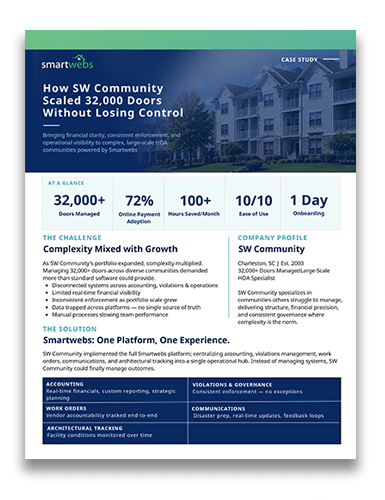
What Scaling Can Look LikeHow SW Community Scaled 32,000 Doors Without Losing Control

Community Financials offers a useful Smartwebs example.

The national HOA and condominium accounting company grew from a startup into an operation serving 400+ communities and 34,000+ homeowners across 36 states, according to the current Smartwebs case study materials. The company adopted Smartwebs in 2022 and later migrated its client base to the platform while continuing its national expansion.

The significance isn’t simply the number of communities.

It’s that accounting technology became part of the company’s operating infrastructure for growth.


Read the SW Community case study


10. What Happens to Your Financial Data If You Switch?

Even if you’ve found better accounting technology, there’s another question:

How do we get from here to there without compromising the integrity of our financial records?

Migration deserves serious scrutiny.

A financial conversion can involve:

  • general ledger balances
  • homeowner balances
  • accounts receivable
  • credits and prepaids
  • assessment and charge structures
  • bank information
  • historical transactions
  • financial reports
  • audit trails

The objective shouldn’t simply be moving data.

It should move and validate the financial information needed to operate confidently in the new environment.

That means reconciling important financial records and confirming that opening balances, receivables, prepaid balances, and other critical information agree with the source system.

We explore that decision in more depth in:

What Is the Real Cost of Not Switching HOA Software? → Link 

Because migration risk matters.

But so does the long-term cost of remaining with technology the organization has already outgrown.


11. Ask Better Questions During the HOA Accounting Software Demo

A feature checklist can tell you whether something exists.

A demonstration should tell you how it actually works.

Instead of asking:

Do you have accounts payable?

Ask:

Show me how an invoice moves from receipt through approval and payment.

Instead of:

Do you have bank reconciliation?

Ask:

Show me the reconciliation process and what happens when something doesn’t match.

Instead of:

Do you have financial reporting?

Ask:

Show me how leadership can understand financial performance across multiple communities without exporting and rebuilding the data.

Instead of:

Do you automate collections?

Ask:

Show me exactly what the system does automatically and where an employee still needs to intervene.

Instead of:

Can you support a large portfolio?

Ask:

Show me what changes in the workflow when we’re managing twice as many communities.

And instead of:

Can you migrate our data?

Ask:

Show me how financial information is validated before we go live.

Those questions make it much harder to hide complexity behind a feature list.

And they give your accounting team something far more useful to evaluate:

the actual work.


The Best HOA Accounting Software Should Help You Run the Business

No single accounting feature determines whether a platform is right for your management company.

The decision comes down to how the pieces work together.

Can your team process receivables efficiently?

Can invoices move through payables without unnecessary manual handling?

Can accountants reconcile bank accounts confidently?

Can boards get understandable financial reporting?

Can managers find answers?

Can leadership see what’s happening?

Can the accounting operation support portfolio growth without complexity growing at the same rate?

And can all of this work alongside the rest of your community-management operation?

Those questions reveal whether you’re buying an accounting system—or building a stronger operating model.

Smartwebs brings accounting together with the workflows management companies use every day, including communications, violations, architectural requests, work orders, homeowner activity, reporting, and automation.

One Platform. One Login. One Unified Experience.

See the Accounting Workflow, Not Just the Feature List

Bring us the processes that matter most to your accounting team.

Receivables. Payables. Reconciliation. Reporting. Collections. Banking. Portfolio visibility.

We’ll show you how those workflows work inside Smartwebs so you can evaluate the system against how your company actually operates.

See Smartwebs Accounting 

Request a demo. →


Frequently Asked Questions About HOA Accounting Software

What is HOA accounting software?

HOA accounting software is technology designed to manage the financial activities of homeowners associations, condominium associations, and the companies that manage them. Depending on the platform, this can include assessments, receivables, payables, bank reconciliation, budgeting, financial reporting, homeowner balances, collections, and related financial workflows.

How is HOA accounting software different from general property management software?

HOA accounting software is designed around community association financial structures and workflows rather than primarily around rental properties, tenants, and leases. Management companies should evaluate whether a platform was designed specifically for the types of associations and financial processes they manage.

What features should HOA management companies look for in accounting software?

Important capabilities include accounts receivable, accounts payable, general ledger functionality, bank reconciliation, budgeting, financial reporting, homeowner account history, collections, banking connectivity, automation, security, portfolio-level visibility, and integration with other community-management workflows.

Can HOA accounting software help a management company scale?

It can. The more accounting work you can standardize, automate, and manage efficiently across communities, the less likely operational complexity is to increase at the same rate as portfolio growth. Buyers should evaluate the actual workflow rather than relying solely on feature claims.

What should I ask during an HOA accounting software demo?

Ask the provider to demonstrate complete workflows. Have them show how an invoice moves from receipt to payment, how a bank account is reconciled, how collections are processed, how financial reports are generated, how leadership views multiple communities, and how financial data is validated during migration.

How important is integrated HOA accounting software?

Integration can reduce duplicate entry and the need to move information manually between systems. For community association management companies, accounting works most effectively when financial information can connect appropriately with homeowner activity, communications, operations, and reporting.

What should a management company consider before switching HOA accounting software?

Consider accounting functionality, workflow efficiency, financial reporting, integrations, data migration, implementation, training, support, scalability, security, and the amount of manual work the new platform can eliminate. Evaluate both the cost of changing systems and the long-term operational cost of remaining with the current system.

The Best Self-Managed HOA Software in 2025: Simplify, Streamline, and Strengthen Your Community

Managing a Self-Managed HOA Just Got Easier 

Running a homeowners association (HOA) on your own is no small feat. Between collecting dues, managing maintenance requests, enforcing violations, and communicating with residents it can quickly feel like a full-time job. 

That’s where self-managed HOA software changes everything. The right solution automates the manual work, improves transparency, and empowers volunteer boards to operate like pros without hiring a management company. 

According to the Foundation for Community Association Research (FCAR), approximately 70–73% of U.S. community associations are professionally managed, meaning about 27–30% operate under self-management—with volunteer boards choosing flexibility, control, and cost savings over outsourcing.

(Source: 2024 Community Association Management Industry Report, CAI)

Why Self-Managed HOAs Need Modern Software 

Self-managed communities juggle a unique mix of responsibilities with limited time and budget. With modern HOA software, your board can: 

  • Automate dues collection, work orders, and violation tracking. 
  • Communicate instantly with residents via text and email.
  • Centralize documents, minutes, and reports. 
  • Increase transparency for homeowners.
  • Save thousands by eliminating third-party management costs. 

The right platform helps volunteer boards stay organized, compliant, and in control, all while keeping residents happier. 

Why Smartwebs Leads the Pack in 2025 

At Smartwebs, we’ve spent more than 16 years perfecting a true all-in-one HOA management solution built for self-managed communities. 

Whether your HOA manages 50 homes or 5,000, Smartwebs makes it simple to handle accounting, violations, architectural requests, and communications all from one easy dashboard. 


Key Features for Self-Managed HOAs 

HOA Accounting Made Effortless 

Stop juggling spreadsheets. Smartwebs automates dues, assessments, and payables while keeping your financials clean and compliant. Generate accurate reports with a few clicks, no CPA required.

Learn more: Smartwebs HOA Accounting 

Architectural Request Management 

Homeowners can submit and track requests online. The board reviews, votes, and approves with full transparency. No lost emails. No delays. 

Violation Tracking Software 

Forget paper trails and manual reminders. Smartwebs automates violations with time-stamped photos, letters, and follow-ups, helping you enforce rules fairly and consistently.
See how: Violation Tracking Tools 

Built-In Communication Tools 

Send community updates, meeting notices, and urgent alerts instantly by text or email. Keep every homeowner in the loop, all in one secure portal. 

A Truly Intuitive Platform 

Designed for real people, not IT experts. Even volunteer board members can confidently navigate Smartwebs after one quick training. 


How Smartwebs Compares in 2025 

When evaluating HOA software, the difference often comes down to integration, support, and scalability. 

Feature  Smartwebs (2025)  HOA Life  PayHOA  AppFolio* 
All-in-One Platform  ✅ Yes  ❌ Limited  ✅ Partial  ✅ For pros only 
Accounting Automation  ✅ Full  ❌ Manual  ✅ Basic  ✅ Advanced 
Violation Tracking  ✅ Automated  ✅ Basic  ✅ Basic  ✅ Advanced 
Communication Tools  ✅ Text & Email  ✅ Email only  ✅ Email  ✅ Email 
Live Customer Support  ✅ Included  ❌ No  ✅ Email only  ✅ Limited 
Built for Self-Managed HOAs  ✅ Yes  ✅ Yes  ✅ Yes  ❌ No 

*AppFolio focuses on professional property managers, not self-managed communities. 

Smartwebs gives self-managed HOAs the same power and precision as enterprise-level platforms without the complexity or cost. 


How to Choose the Right HOA Software 

When evaluating software options, prioritize: 

  1. Scalability – Can it grow as your community expands? 
  1. Ease of Use – Can everyone, from treasurer to homeowner, navigate it easily? 
  1. Automation – Does it handle repetitive tasks so your board doesn’t have to? 
  1. Support – Will someone actually answer when you need help? 
  1. Cost Transparency – No surprise fees, no add-ons for basic features. 

Smartwebs checks every box. 


Frequently Asked Questions 

What is self-managed HOA software?
It’s purpose-built technology for communities that prefer to handle management in-house. It automates accounting, communication, and compliance freeing volunteer boards from manual work. 

Is Smartwebs good for small communities?
Absolutely. Smartwebs scales to your needs, making it ideal for both small and large self-managed HOAs. 

How much does Smartwebs cost?
Pricing depends on your community size and features. Request a demo for a personalized quote. 

Does Smartwebs offer accounting tools?
Yes. Our platform includes full HOA accounting automation with reporting, AR/AP, and real-time dashboards. 


Final Thoughts 

Self-managing your HOA doesn’t have to mean doing it alone. With Smartwebs, you get the modern tools, automation, and support to run your community like a pro. 

Start saving time, reducing costs, and creating a more connected neighborhood today. 

 Schedule a Free Demo


Looking for additional resources? Check out CAI’s guide to HOA self-management for expert advice.