Best Practices for Submitting HOA Work Orders

The homeowner association (HOA) work order process is critical to keeping a well-maintained community. Submitting accurate, detailed work orders can help preserve the “curb appeal” and value of your community association. Below we have laid out the best practices to follow when submitting work orders to a vendor, so keep reading!

What is Considered a Work Order?

A work order is a request for a service or repair of any community equipment (i.e., pool, volleyball courts, playgrounds, etc.). Work orders can help track, manage and pay for vendor services. They are used by homeowners, property managers, and community managers.

Understanding the difference between a work order and a community improvement is also important to note as these are separate items and should be handled as so. Again, a work order is submitted when something existing needs to be fixed or repaired. A community improvement would be a nice item for the community to have or add to its current amenities. An example of a community improvement would be to add lighting to tennis courts to so it can be used at nighttime. This is not a work order to fix lighting that is already existing, but instead to add lighting that isn’t already there. 

Is There HOA Software That Can Help Manage Work Orders?

Yes! There are many options for HOAs to submit work orders for their community associations. Our software SmartWorkers helps you automate your work order process and help keep everyone informed along the way. Homeowners submit requests online and receive an automated email notifying them that it’s being processed. Staff will review the submission and assign a vendor who will be notified via email, text, or voice message. Then you can easily track work orders with our unique link, so you always know the status.

Our mobile app gives you on-the-go access to view all HOA work orders quicker! Virtual community maps with GPS navigation can route vendors to the item’s exact location. Vendors have immediate access to all information to get started and capture real-time updates with photos that notify everyone of progress.

Best Practices for Submitting HOA Work Orders

When you submit a work order, it’s important to follow these best practices to ensure your request is processed as quickly and efficiently as possible:

Make Sure It’s Detailed

Include as much detail as possible about the nature of the request, how long it has been an issue, how frequently (or infrequently) it occurs, and any other relevant details that may help the vendor understand the problem.

Include Photos

Include photos of the problem area(s). Images are helpful because they provide visual proof of what needs to be addressed and can also help with identification purposes if there are multiple people submitting similar requests for different reasons. Regarding specifically related issues such as interior damage caused by leaks or exterior damage caused by storm damage/wind storms/etc., including photos may also help determine whether additional repairs might be needed.

Include Your Contact Info

Even if you submit a very informative and thorough request, a vendor could still have questions regarding the issue. That’s why it will be important to include the best way to contact you for any questions regarding the work order. 

Conclusion

HOA work orders help your community stay ahead of issues and make sure things are fixed promptly. It will be essential to keep track of any work orders, so your community thrives. Having software in place helps you do it! The process can be automated, so you no longer have to use pen and paper to ensure your issues are resolved. 

Our team would love to show you the power of SmartWorkorders. We will walk you through a detailed demo showing how your community can use our software to solve some of your work order pain points. Contact us today to schedule a demo!


5 Tips For Handling HOA Architectural Requests

Introduction

HOAs are responsible for maintaining the safety and aesthetics of their neighborhoods. Having a consistent way to deal with your architectural requests will help your community association. You might need residents to get approval before painting their front door a different color or building an addition to their house. We know it can be challenging to keep track of all the architectural requests in your community, so here are some tips for handling your HOA architectural requests! 

Educate Your homeowners On Your Policies

It’s essential to make sure your homeowners are aware of your policies. Ensure that they are fully informed about the rules, expectations of any fees, as well as how to submit requests for their property.

Outline your policies in an easy-to-read document, so it’s not confusing for homeowners. You can minimize the number of rejected requests by simply creating a clear policy document!

Make Sure HOA Architectural Requests Are Uniform

The first thing to consider when managing HOA architectural requests is whether or not they are uniform. Ensure that all architectural requests are submitted in one format, so you can be sure that any request is handled consistently. If the format of your architectural requests is inconsistent, there will be confusion among board members when reviewing them. You also want to make sure that all architectural request forms are clear and easy to read, so no one misses an important detail while reading them.

Make Sure You’re Timely in Your Response

If you have a board member dealing with the request, be sure that they are responsive to residents’ questions and concerns. The quicker you can respond, the better.

It’s also important to let residents know when your board will be reviewing their request and if there will be any delays in making a decision. If it helps, you can set up regular meetings with your Architectural Committee or Board of Directors. This would allow them to make decisions on all requests at once instead of having several people come forward with individual requests that need separate considerations from other projects being considered by the Architectural Committee or Board of Directors. 

Timeliness is critical for handling HOA architectural requests. If you don’t respond to residents about the status of their request within two weeks, they may assume that it’s been rejected, which can lead to frustration and low perception of your responsiveness.

Be Consistent in Approvals and Rejections

It’s important to be consistent in your approach to architectural requests and in the way you communicate decisions. This is especially true for the more common requests, such as changing front door colors, adding shutters or columns, installing a new mailbox post, or adding fencing. If you reject one request because there are too many similar ones already on the street, then it’s important that you also reject subsequent requests for those reasons.

If a homeowner submits an application for approval of plans for an addition or modification and it fails on some technicality (such as not being complete), don’t automatically grant approval just because other homeowners were able to get theirs approved without any problems. You need to maintain consistency so homeowners understand how they can get what they want while staying within HOA guidelines.

Use HOA Software to Help Manage Requests

You can use software to help manage the approval process. HOA Software enables you to track requests, save time and make your life easier!

  • It helps you manage the approval process by tracking all requests uniformly so that everyone knows what’s going on.
  • It also helps with consistency: when using software for approvals, it’s easy to have consistent standards across all projects and homeowners because everything is managed from one central location.
  • Board members will be able to directly vote on architectural requests online from anywhere at any time, making the approval process quicker.
  • Residents will be able to submit architectural requests online from a centralized location and track the progress of their requests from their resident portal.

Are you interested in architectural software? Check out more information about SmartArchitecturals. 

Conclusion

These tips should help you handle HOA architectural requests more efficiently. We know running an HOA is stressful, but Smartwebs is here to make it easier! With our software, you’ll be able to track, manage, and approve architectural requests from your residents. Schedule a demo with our team. 


What HOA Management Issues Does Software Solve?

HOA management software is a great way to manage the day to day of community association management. It helps you automate many of your tasks and keeps all your information in one place. This software also helps improve resident satisfaction, efficiency, and cost savings.

Accounting

Accounting can be a daunting task but with HOA software, it is much easier to manage. With software like Smartbooks you’ll be able to:

  • Centralize all of your community documents
  • Easily integrate with your banks
  • Manage all of your accounts in one place

SmartBooks is a cloud-based, bank-integrated accounting software to manage all of your HOA accounts, documents, payments and so much more under one login. Our smart, yet the simple interface is easy to use, which makes managing your community faster than ever before.

Resident Communication

Communication can help create a sense of community and involvement, which are essential to creating a positive environment for residents to live in.

Clear communication is also vital when managing an HOA. To make sure everyone is on board with your plans and that they understand the reasoning behind them, it’s essential to communicate well with your residents from day one. If you focus on good communication from the start, this will continue for the rest of your tenure as an HOA manager—and beyond!

With SmartCommunications, we help you do just that. You can easily text or email your residents with just a couple of clicks. With SmartPortal residents can contact you directly through the software so you can keep better track of your communication with them. 

Amenities Maintenance

Amenities maintenance is one of the larger responsibilities for HOAs and something that can be difficult to manage without a dedicated system in place.

Work order software has several advantages over manual methods of tracking and scheduling maintenance requests:

  • It can track which members have made requests for repairs or improvements on their properties. This means that you won’t have multiple people calling about the same issue or trying to schedule work at the same time—you’ll know exactly who needs what, when they need it and how much time they need before you can get someone out there.
  • The process becomes streamlined because all requests are logged electronically instead of being left on pieces of paper around town where they may get lost or misplaced.

Violation Creation and Tracking 

HOA violation software is a helpful tool for HOAs. It helps you stay organized and keep track of violations in your community. If you want to manage your HOA more effectively, violation software will help you do that!

You can use HOA violation software to:

  • Track violations as they happen. With our mobile app, you will be able to drive the community and easily manage and track violations. You don’t even need cell service! Our offline app will download your community map before you even start your drive and our GPS system will follow you as you’re making your rounds.
  • Automatically send out violation letters. With our Zero-Touch Mailing service, you will be able to send out letters directly to homeowners without printing and stuffing envelopes yourself. Once you’ve completed your community drive and get back to the office you’ll simply process the violations and the system will do the rest!

There are so many issues that can arise when managing an HOA community but having the right systems in place will be a huge asset to you. We recommend outlining your wants and needs for a software provider and then demoing multiple solutions until you find the right fit for your community. We think the clear choice is Smartwebs but ultimately you have to choose the right solution for you. If you’d like to demo our HOA management software, contact our team!


4 Traits of a Good HOA Manager

Managing a homeowners association is no joke! As an HOA manager, you need to be able to do everything from scheduling meetings and managing finances to overseeing maintenance and keeping the place safe. A good HOA manager needs many skills—but the good news is that you can learn them all! Here are four of the most important traits of a good HOA manager.

HOA Manager Job Description

What services does the HOA management company offer? The duties of an HOA manager or management company include managing the community’s overall operations and day-to-day activities.

A group of managers known as the board of directors is in charge of overseeing homeowners organizations. However, board members frequently lack the time and expertise needed to carry out management duties. For support, many associations employ an HOA management company or manager.

Remember that not all businesses provide the same services. The agreed-upon services outlined in the management contract will determine the precise duties held by the HOA manager. However, common duties for an HOA property management company do exist, including but not restricted to the following:

  • Understand the CC&Rs or governing papers of the HOA
  • Make sure the HOA conforms with all applicable federal, state, and local
  • Assist with budget preparation
  • Ensuring that the HOA keeps within its budget
  • Dues and assessments
  • Monitor invoices, receivables, payables, and delinquencies
  • Obtain the appropriate insurance coverage
  • Report managerial and financial reports to the board on a monthly basis.
  • Plan and attend board meetings
  • Document and keep records of meeting minutes
  • Violation Inspections
  • Enforce rules and regulations on a consistent basis
  • Provide recommendations to update policies as needed
  • Address homeowner concerns and questions
  • Update members through communication channels
  • Send resident notices
  • Maintain and properly insure common areas
  • Govern projects
  • Resolve community disputes or discrepancies
  • Promote board elections
  • Tax Preparation
  • Provide the board advice on various issues and decisions
  • Work alongside experts like lawyers, accountants, reserve specialists, etc.

Hiring an HOA Manager

Are HOA management companies and HOA managers the same thing? HOA management companies are firms that offer management services for homeowners associations, albeit they do share the same duties. HOA managers, on the other hand, are the ones that associations really work with.

An HOA manager will normally be assigned to your neighborhood if you select an HOA management company. You can’t collaborate with a faceless corporation, after all. Having several point people for various management duties is also impracticable. The operations of the community will be managed by an HOA manager, who will also assist the board and serve as a liaison between you and the management firm.

Traits of a good HOA manager

How can you tell whether your HOA manager is skillful? One technique is to see whether they attempt to go above and beyond the responsibilities of the HOA property manager. This demonstrates their genuine concern for your community and that they go above and above the call of duty. These are additional crucial characteristics of an HOA manager.

#1. They Can Manage Financials

A good HOA manager will ensure the financials are managed correctly. Handling revenue, expenses, and budgeting is a key part of the job, and it needs to be done well in order for the HOA to function optimally. A good manager will be on top of all financial activities:

  • Determining monthly fees from members
  • Tracking payments from members
  • Creating budgets based on estimated expenses for each year
  • Keeping an eye out for unexpected costs that may arise throughout the year (e.g., if there’s a calamity that causes damage to common areas)

HOA software tools are available to help manage these tasks. For example, Smartwebs HOA Accounting Software offers a complete package with many useful features including:

  • Reporting capabilities
  • Centralize all of your community documents
  • Easily integrate with your banks
  • Manage all of your accounts in one place
  • Residents can see real-time balances

#2. They Communicate Effectively

While effective communication is a vital part of every relationship, it’s especially important for an HOA manager to be able to communicate effectively. This includes communicating with homeowners and board members as well as vendors and contractors. After all, if your HOA manager can’t communicate well, how will they be able to make sure projects get done on time and on a budget?

When it comes to good communication skills, it’s always better to over-communicate than under-communicate. It’s also important to have the right tools in place for your HOA manager to easily communicate with homeowners. Smartwebs HOA Communication Software helps managers do just that! They can easily email or text residents individually or even send out mass communications to the entire community. 

#3. They Stay Up-to-Date

It’s important for HOA managers to stay up-to-date with changes in the law and industry, so they can provide accurate information to their boards. Regularly attending local seminars and state or national conferences is a great way to acquire continuing education credits. These events also give you the opportunity to meet other people who share your interests and chat with vendors and suppliers who might have new products or resources you need.

Trade publications are an excellent source of news and articles from experts in the field, so make sure you’re subscribed to at least a few of these magazines. The most popular trade magazine for homeowners association professionals is Community Associations Institute (CAI), which has over 45 years’ worth of content addressing topics including but not limited to board management, managing multiple HOAs as a consultant/manager, budgeting/finances, and even using social media effectively when working with your communities.

Lastly, it’s important that HOA managers have a good understanding of the community’s governing documents or covenants—including bylaws, CC&Rs, policies & procedures—and how they relate to state laws regarding homeowner associations. Thorough knowledge of these governing documents will help ensure that the manager abides by them when making decisions on behalf of their HOA boards. You should also know where residents can find copies of these documents if they’re unfamiliar with them; many HOAs post their governing documents on their website for members’ use.

#4. They Know the Rules

The rules in a homeowners association are only as good as their enforcement. If the HOA manager is unable to apply them fairly, they’re not worth the paper they’re written on. The board will establish rules with the best of intentions and they must be enforced consistently in order to keep conflict at bay and to protect the integrity of your neighborhood.

It can be difficult for an HOA manager to keep up with all the rules and regulations (particularly among larger communities where it’s easy for different HOAs to have slightly different bylaws) but once you get the hang of it, you’ll find that it becomes second nature. Managing violations can be a daunting task but with Smartwebs HOA Violation Software, it doesn’t have to be! With our HOA software, you can easily track, submit, and report on community violations with just a few clicks. 

You’ve Got This.

HOA management can be a busy job but one that is also rewarding! Having the right HOA software will be key to being a good manager as it will help you do your job more efficiently. Schedule a demo with our team today to see how Smartwebs can help you. 

What Is HOA Accounting Software? A Complete Guide for Community Associations

What Is HOA Accounting Software? A Complete Guide for Community Associations

Updated September 2026

HOA accounting isn’t quite the same as accounting for a traditional business.

Community associations collect assessments from homeowners, manage operating and reserve funds, pay vendors, reconcile bank accounts, track homeowner balances, prepare budgets, and provide financial information to boards—all while maintaining accurate records for each individual association.

For a management company overseeing dozens or hundreds of communities, that complexity multiplies quickly.

That’s where HOA accounting software comes in.

Quick Answer: What is HOA accounting software?
HOA accounting software is financial management technology designed specifically for homeowners associations and the companies that manage them. It helps manage association-specific financial processes including homeowner assessments, accounts receivable, accounts payable, bank reconciliation, budgeting, financial reporting, homeowner balances, collections, and transaction histories.

The best HOA accounting technology does more than record what happened financially.

It helps accounting teams maintain accurate records, gives managers and boards better financial visibility, reduces repetitive administrative work, and creates a financial foundation capable of supporting a growing portfolio.


Why Is HOA Accounting Different From Traditional Business Accounting?

At its core, accounting is still accounting.

Money comes in. Money goes out. Transactions are recorded. Accounts are reconciled. Budgets and financial statements help people understand financial performance.

But the environment surrounding HOA accounting is different.

A community association has homeowners paying assessments rather than traditional customers buying products. It has operating expenses, reserve funds, vendor obligations, budgets, bank accounts, homeowner balances, delinquencies, board oversight, and reporting requirements specific to the association.

A community association management company may be responsible for those processes across many separate associations at the same time.

That creates an important distinction.

A general accounting system is primarily designed to maintain financial records for a business.

HOA accounting software is designed around the financial relationships between associations, homeowners, boards, vendors, banks, and the management companies serving them.

That context matters.


What Does HOA Accounting Software Do?

HOA accounting software brings the core financial processes involved in managing a community association into a system designed around those workflows.

While capabilities vary by platform, the fundamental functions generally include the following.

Assessment Billing and Accounts Receivable

Associations depend on assessments to fund community operations.

HOA accounting software can help create recurring charges, maintain homeowner balances, record payments, manage adjustments and late fees, track delinquencies, and maintain account histories.

For management companies, automation becomes especially important because recurring processes multiply with every community added to the portfolio.

Accounts Payable

Associations regularly pay landscapers, maintenance providers, utilities, insurance providers, contractors, and other vendors.

Accounting software helps teams manage the financial workflow surrounding those obligations, including invoice processing, approvals, payments, vendor records, and transaction history.

The objective isn’t simply to pay bills electronically.

It’s to create a consistent, controlled process from invoice to payment.

Bank Reconciliation

Reconciliation helps confirm that the activity recorded in the accounting system aligns with the activity occurring in the association’s bank accounts.

HOA accounting software can make that process more efficient by bringing banking and accounting information closer together and helping accounting teams identify transactions or discrepancies requiring attention.

For a management company handling many associations, the efficiency of this process can have a significant impact on accounting workload.

Budgeting

Association budgets help boards understand anticipated income, expenses, and financial obligations.

Accounting technology can support budget creation and monitoring while helping teams compare actual financial activity against budgeted expectations.

That gives accounting teams, managers, and boards better visibility into how the association is performing throughout the year.

Financial Reporting

Financial reports turn accounting data into information people can use.

Depending on the association and platform, reporting may include balance sheets, income and expense statements, general ledgers, accounts receivable and payable reports, budget comparisons, cash information, and other financial statements.

Good reporting isn’t simply about producing more reports.

It’s about making reliable financial information easier for the appropriate people to understand and use.

Homeowner Account Management

Each homeowner has a financial relationship with the association.

Accounting software can maintain charges, payments, adjustments, balances, and account history associated with that relationship.

When homeowner account information is accurate and current, managers can answer questions more efficiently and homeowners can have greater confidence in the information they’re receiving.

Collections and Delinquency Management

Past-due assessments require consistent processes.

HOA accounting technology can help teams identify delinquent accounts, apply established charges or fees, document account activity, and support collection workflows.

The goal is consistency and visibility rather than relying on disconnected spreadsheets or manual tracking.

Audit Trails and Financial Controls

Financial systems should maintain a clear history of transactions and activity.

Permissions, approval processes, transaction histories, documentation, and audit trails help accounting teams maintain stronger controls and provide greater visibility into what happened, when it happened, and where appropriate, who took an action.


HOA Accounting Software vs. General Accounting Software

General accounting platforms can be excellent tools.

But they aren’t necessarily designed around community association management.

General Accounting Software HOA Accounting Software
Designed for general businesses Designed around community associations
Standard customer receivables Homeowner assessments and balances
General AP and vendor management Association-specific AP and vendor workflows
Company-level budgeting Individual community budgets
Standard bank reconciliation Reconciliation across association bank relationships
General financial statements Association and board financial reporting
Customer records Homeowner financial histories
Usually one business environment Can support many separate associations within a management portfolio

The distinction becomes increasingly important as the number of communities being managed grows.

A self-managed association may have one set of books.

A community association management company may manage hundreds.


HOA Accounting Software vs. HOA Management Software

The terms are sometimes used interchangeably, but they don’t necessarily mean the same thing.

HOA accounting software primarily supports the financial operation of an association: assessments, receivables, payables, reconciliation, budgets, banking, homeowner balances, and financial reporting.

HOA management software can encompass a much broader range of operational functions, including violations, architectural requests, work orders, communications, resident portals, documents, tasks, vendors, reporting, facilities, and other community-management workflows.

Some technology platforms connect both.

That matters because accounting rarely operates entirely by itself.

Homeowners interact with financial information.

Managers answer financial questions.

Vendor activity can create payables.

Boards depend on financial reporting.

Leadership needs visibility across the portfolio.

When accounting and community operations exist in disconnected systems, employees often become the integration layer—moving information between platforms and filling gaps manually.

A connected platform can reduce those handoffs.


Who Uses HOA Accounting Software?

HOA accounting software serves several different users, and they don’t all need the same information.

Accounting teams use it to manage financial transactions, receivables, payables, reconciliation, reporting, budgets, and controls.

Community managers need appropriate financial visibility to manage communities and respond to board and homeowner questions.

Management-company leadership needs visibility across a portfolio to understand workload, financial operations, exceptions, and scalability.

Boards rely on accurate financial information to make decisions and fulfill their governance responsibilities.

Homeowners interact with appropriate portions of the financial system through activities such as paying assessments and viewing account information.

Self-managed associations may use HOA accounting technology to manage these processes without a professional management company.

The common requirement is the same:

Accurate financial information needs to reach the appropriate person without creating unnecessary work along the way.


What Are the Benefits of HOA Accounting Software?

The value of HOA accounting software isn’t simply that it moves bookkeeping onto a computer.

Modern technology can improve the financial operation in several ways.

Less repetitive work. Automation can reduce manual effort surrounding recurring financial processes.

Greater consistency. Standardized workflows help teams perform routine accounting processes more consistently across communities.

Better accuracy. Reducing unnecessary manual entry can reduce opportunities for avoidable errors.

Greater financial visibility. Connected financial information makes it easier for accounting teams, managers, boards, and leadership to access the information appropriate to them.

Improved homeowner experience. Clear balances, payment options, and current account information can reduce confusion and routine questions.

Stronger operational capacity. Efficient systems can help management companies handle greater transaction volume without requiring administrative work to increase at exactly the same rate.

More scalable operations. Standardized financial processes become increasingly valuable as a management company’s portfolio expands.

Current Vantaca accounting content similarly emphasizes that modern HOA accounting has moved beyond bookkeeping toward accuracy, controls, visibility, risk reduction, and scalability.

For a deeper look at the visibility side of the equation, read Streamline HOA Finances: How Modern HOA Accounting Software Improves Transparency and Saves Time.


What Features Should HOA Accounting Software Include?

Not every organization needs exactly the same configuration, but core capabilities typically deserve close evaluation.

Look at accounts receivable and assessment billing, accounts payable, bank reconciliation, budgeting, financial reporting, homeowner account histories, collections workflows, banking connectivity, payment processing, audit trails, permissions, automation, integrations, security, portfolio-level reporting, implementation, and data migration.

But a feature existing doesn’t tell you whether it works well.

That’s why buyers should move beyond:

“Does the software have bank reconciliation?”

and ask:

“Show us how your bank reconciliation process actually works.”

Instead of:

“Do you have accounts payable?”

ask:

“Show us how an invoice moves from receipt through approval and payment.”

The distinction is important.

Feature lists tell you what software claims to have. Workflows show you how your team will actually work.

For the full evaluation process, see How to Choose the Best HOA Accounting Software for Your Management Company.


How Does HOA Accounting Software Improve Financial Transparency?

Financial transparency doesn’t mean giving everyone unrestricted access to accounting information.

It means providing appropriate stakeholders with accurate, timely, understandable financial information.

For boards, that can mean receiving current financial reports with enough time to review them before making decisions.

For managers, it can mean accessing appropriate financial information without repeatedly asking accounting to build a report.

For homeowners, it can mean seeing accurate balances and payment histories.

For leadership, it can mean understanding financial operations across a portfolio.

And for accounting teams, transparency begins with accurate records, reliable processes, controls, and reconciliation.

CINC’s current integrated-accounting content similarly emphasizes bringing financial information together so managers can access a more complete financial picture and produce reports more efficiently.

The important principle is:

Visibility without accuracy isn’t financial transparency.

Accuracy has to come first.


How Does HOA Accounting Software Help a Management Company Scale?2026 Community Financials Case Study (9-15-2026)

This is where HOA accounting software becomes more than a bookkeeping tool.

Imagine one community.

It has a budget, bank accounts, homeowner balances, assessments, payments, invoices, vendors, reconciliations, reports, and a board.

Now multiply those financial relationships across 50 communities.

Then 100.

Then 400.

Growth creates more transactions, more bank activity, more invoices, more payments, more reporting, more homeowner questions, and more exceptions.

If every additional community requires a proportional increase in manual accounting work, the technology isn’t really helping the organization scale.

Scalable HOA accounting technology should help standardize processes, automate appropriate repetitive work, maintain financial controls, and preserve visibility as transaction volume grows.

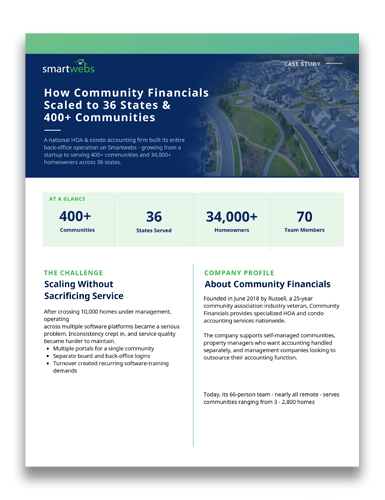
Community Financials demonstrates what that can look like at substantial scale.

The national HOA and condominium accounting firm operates across approximately 400 communities and 30,000 homeowners in 36 states. After passing 10,000 homes, managing staff across multiple software platforms had become increasingly difficult. Since adopting Smartwebs in 2022, the company has migrated its customer base onto the platform while continuing to grow nationally.

That’s not simply an accounting-software story.

It’s an example of why the underlying operating model matters as an organization grows.

Read the Community Financials case study


Can HOA Accounting Software Actually Save Time?How SW Community Scaled 32,000 Doors Without Losing Control

Yes, but “saves time” should be more than a marketing claim.

The better question is:

Where does it save time, and how much?

Look for reduced manual entry, more efficient invoice workflows, easier reconciliation, fewer reporting workarounds, faster access to information, fewer disconnected systems, and less time spent moving data between them.

And ask prospective providers for evidence.

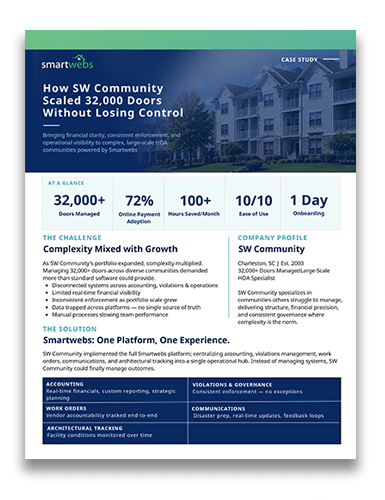
SW Community provides one Smartwebs example.

The large-scale management company manages more than 32,000 doors. Before Smartwebs, its accounting, violations, and operational systems were disconnected, financial visibility was limited, and manual processes slowed the team down.

After centralizing those functions on Smartwebs, SW Community reports 100+ hours saved per month, 72% online payment adoption, greater real-time financial visibility, and a more centralized operating environment.

That’s considerably more useful to a buyer than simply being told software is “efficient.”

Read the SW Community case study


What Does HOA Accounting Software Cost?

There isn’t one standard pricing model for HOA accounting software.

Pricing can vary based on factors such as the number of homes or units, associations, users, modules, functionality, implementation requirements, integrations, payment services, and the provider’s broader business model.

That’s why comparing two platforms solely on their advertised subscription price can be misleading.

The more useful question is:

What does this technology cost our organization to operate?

Consider the software price alongside implementation, integrations, required third-party tools, payment-related costs, support, internal labor, manual processes, and the additional systems employees need to accomplish their work.

A platform with a lower subscription price can still create a higher operating cost if employees spend significantly more time working around it.

Conversely, a more expensive platform isn’t automatically a better investment.

Price matters. Value matters more.

For a deeper evaluation of that question, read Your HOA Software Costs More. Are You Getting More Value?


When Should an HOA or Management Company Consider New Accounting Software?

You don’t need to replace accounting software simply because something newer exists.

The better question is whether the current system still supports the organization effectively.

Potential warning signs include growing dependence on spreadsheets, duplicate data entry, manual reconciliation, difficulty producing reports, disconnected systems, limited financial visibility, increasing administrative workload, or technology that becomes harder to manage as the portfolio grows.

For management companies, another useful question is:

If our portfolio doubled, what would happen to the accounting workload?

If the answer is that people, manual processes, spreadsheets, and administrative complexity would need to double too, the organization may have a scalability problem rather than simply an accounting problem.

That doesn’t automatically mean switching is the answer.

But it does mean the current operating model deserves evaluation.

For more on that decision, read What Is the Real Cost of Not Switching HOA Software?


How Should You Evaluate HOA Accounting Software?

Start with your actual workflows.

Don’t begin with a vendor’s feature checklist.

Bring the processes your team performs every day:

Receivables.

Payables.

Reconciliation.

Financial reporting.

Budgeting.

Collections.

Homeowner account questions.

Banking.

Portfolio reporting.

Then ask the provider to show you how those processes work inside the system.

Evaluate not only whether the functionality exists, but how many steps it requires, where manual intervention remains, what information is available to different users, how exceptions are handled, and what happens as your organization grows.

Current HOA software buyers face many platforms making similar promises about efficiency and growth; Vantaca’s 2026 buyer guidance likewise argues that buyers need to look beyond surface-level feature comparisons and understand the operating model behind the technology.

The software should fit the way your organization needs to work—not force your organization to build increasingly complicated processes around the software.


HOA Accounting With Smartwebs

Smartwebs approaches accounting as part of the broader community-management operation.

Accounting connects with the people and processes surrounding it—community managers, homeowners, boards, vendors, communications, reporting, workflows, and operational activity.

Bringing those functions into a connected environment reduces the need for employees to move between disconnected systems simply to understand what’s happening in a community.

For organizations managing complex portfolios, that connection becomes increasingly valuable as they grow.

One Login. One Unified Experience.

The objective isn’t simply to give your accounting team another piece of software.

It’s to give the organization a stronger financial and operational foundation.

See How HOA Accounting Works Inside Smartwebs

If you’re evaluating HOA accounting technology, bring us the workflows that matter most to your team.

Receivables. Payables. Reconciliation. Reporting. Banking. Collections. Portfolio visibility.

We’ll show you how those workflows work inside Smartwebs so you can evaluate the platform against how your organization actually works.

See Smartwebs in action.

Request a demo. →


Frequently Asked Questions

What is HOA accounting software?

HOA accounting software is financial management technology designed for homeowners associations and the companies that manage them. It supports association-specific processes such as homeowner assessments, accounts receivable, accounts payable, bank reconciliation, budgeting, reporting, homeowner balances, collections, and transaction histories.

How is HOA accounting software different from general accounting software?

General accounting software is designed for standard business accounting. HOA accounting software is designed around the financial relationships and workflows of community associations, including homeowner assessments, association budgets, board reporting, community bank accounts, and potentially multiple associations within one management portfolio.

Is HOA accounting software the same as HOA management software?

Not necessarily. HOA accounting software focuses primarily on financial operations. HOA management software may also include violations, architectural requests, work orders, communications, resident portals, documents, reporting, and other operational workflows. Some platforms combine both.

Who uses HOA accounting software?

Professional management companies, accounting teams, community managers, self-managed associations, and other professionals responsible for association finances may use HOA accounting software. Boards and homeowners may also access relevant financial information produced through the system.

What features should HOA accounting software have?

Core capabilities may include assessment billing, accounts receivable, accounts payable, bank reconciliation, budgeting, financial reporting, homeowner account histories, collections workflows, payment processing, banking connectivity, permissions, audit trails, automation, and integrations.

Can HOA accounting software manage multiple associations?

Platforms designed for professional community association management can support financial operations across multiple associations. Management companies should evaluate how effectively a system maintains separation, consistency, reporting, controls, and visibility as the portfolio grows.

Does HOA accounting software handle homeowner payments?

Many HOA accounting platforms support homeowner payment processing and account tracking. Exact payment methods, processing models, fees, integrations, and capabilities vary by provider and should be reviewed during evaluation.

Can HOA accounting software help with bank reconciliation?

Yes. Bank reconciliation is a core function of HOA accounting technology. Buyers should evaluate not merely whether reconciliation is offered but how transactions are matched, exceptions are handled, and accounting teams manage reconciliation across multiple associations.

How much does HOA accounting software cost?

Pricing varies by provider and may depend on homes or units, associations, users, functionality, modules, implementation, integrations, payments, and other services. Buyers should consider total operating cost rather than comparing subscription prices alone.

Can you switch HOA accounting software without losing historical data?

Historical data can often be migrated, but the amount, format, process, and validation vary by provider. Before switching, organizations should establish exactly which financial data will move, how it will be validated, what historical information will remain accessible, and what will happen before the new system goes live.


How to Attract Top Talent for Your HOA Community

Ask Yourself What Makes Your HOA Community Unique

How do you attract top talent to your HOA? Your community’s mission statement, vision, and culture are some of the most important factors determining whether it attracts top talent or repels prospective residents. To get a step ahead of the game, it’s important to consider what makes your community unique. Is it in a desirable location? Is it in a city that’s known for its art scene? A university town? If you’re putting together an ad for potential candidates, ask the following questions to make sure you’re appealing to who you want to be:

  • What is your community’s mission statement and vision?
  • What is the reputation of your community and how has it been established in your market?
  • What are the values that define your community (e.g., caring about family members, environmentalism, etc.)?
  • What is the culture of your community (e.g., we’re a low-key place where people take care of their neighbors)?
  • Who are the current residents and what draws them to live there?

Offer Competitive Benefits to HOA Employees

It can be hard to stand out as an employer and entice qualified candidates in a competitive hiring market. Fortunately, you have a secret weapon: benefits. By offering certain kinds of benefits, you can make your HOA community an attractive place for potential employees to work.

Benefits are something that employees and job seekers value highly in their careers, so offering good benefits is a great way to attract top candidates. As you’re building your list of benefits for HOA employees, include both tangible and intangible options so that there’s something for everyone.

Tangible perks might include paid time off (PTO), paid sick leave, free parking or other transportation reimbursement options, help with continuing education and training expenses, or discounts at local businesses that your employees frequent. Intangible perks might include flexible scheduling options, unlimited vacation days, or a casual dress code. Offering these kinds of benefits may also help you attract younger talent—millennials are especially attracted to workplaces with a flexible culture.

Create Clear Job Descriptions

To attract top talent to your HOA community, you must make sure to have a clear job description posted. Your job description should provide a list of responsibilities and what you expect out of an employee.

Here are some elements to include:

  • Job title
  • Company name
  • Full description of the job
  • Requirements and qualifications needed

Make The Interview Process Smooth, Efficient, and Enjoyable

Now that you have a pipeline of candidates to interview, it’s important to make your interview process as smooth and efficient as possible. Nobody likes interviewing for a job. But with the right approach, your company can make the interview process enjoyable for everyone involved.

Before an interview is scheduled, be sure you’re clear about what the next steps will look like and when they’ll happen—for example if you’ll be doing onsite interviews or phone screens before making a final hiring decision, let candidates know that in advance so they don’t get their hopes up unnecessarily (or worse yet, cancel another potentially better opportunity).

Then, once that candidate has an offer in hand, follow up with them as soon as possible—especially if they’re also interviewing at other places. You want to make sure they have all the information they need to decide while it’s still fresh in their minds.

After an offer is accepted:

  • Be very clear and upfront about when the new person will start working at your company. If there’s a delay in starting due to visa issues or some other external factor (like Covid-19), keep them informed of any changes to this timeline so there aren’t any surprises along the way. If possible send them regular updates on what’s happening until their first day does arrive; this will help build trust between both parties before work even begins!

Consider Working With an Employment Recruiter

  • Consider working with an employment recruiter. An experienced recruiter can help you connect with the best candidates for your HOA’s open positions. They will act as a liaison between you and the highly qualified people who may not be actively looking for a job but would jump at the chance to work for your community association. The recruiter will save you time, as they are able to source potential employees quickly, and money, as they are able to define exactly what qualities in a candidate make them right for your HOA community.

Ready For Your Next Great Employee

Attracting excellent talent to your HOA community can seem challenging, but if you know how to market effectively and build the right team of people, the results are worth it.

To attract top talent to your HOA community, you need to build a strong team. This is not an easy or quick feat, and it will take time and resources, but it’s an important step in building the foundation of your company.

To build this team, you will need to network! Your team should be made up of people who have different skills and experience. Networking helps you find talent that isn’t limited to what’s available on the market right now.

We hope you find your next great employee and that these tips help you do just that. Once you’ve hired the right person, make sure they have the right tools! Smartwebs helps HOA community managers do their job with ease. Schedule a demo with our team today to see what Smartwebs can do for you. 


3 Tips for How to Write a Violation Letter Template

Introduction

Welcome to our comprehensive guide on writing HOA violation letter templates. In this article, we will provide you with expert tips and insights to help you effectively communicate violations to homeowners. Whether you’re an HOA board member, property manager, or homeowner, understanding how to write an HOA violation letter template is essential for maintaining a harmonious living environment. We’ll cover everything from the structure of the letter to key elements you should include. Let’s dive in!

HOA Communities: 3 Tips for How to Write a Violation Letter Template

Tip 1: Start with a Clear and Professional Salutation

The first course of action in creating an effective violation letter template is to begin with a clear and professional salutation. Address the recipient by their name, such as “Dear Mr. Smith” or “Dear Mrs. Johnson.” Using a personalized salutation adds a touch of professionalism and shows respect for the homeowner.

Tip 2: Clearly State the Violation and Provide Supporting Evidence

When writing a violation letter template, it’s crucial to clearly state the violation at hand. Begin by describing the specific rule or regulation that has been violated. For example, if the violation involves unauthorized modifications to the property, mention the relevant section of the HOA guidelines that prohibits such modifications.

To strengthen your case, provide supporting evidence to substantiate the violation. This can include photographs, witness statements, or any other relevant documentation. Be sure to include these as attachments or references within the letter to ensure the recipient has a clear understanding of the violation.

Tip 3: Outline Consequences and Provide a Path to Resolution

In order to effectively convey the importance of addressing the violation, it’s essential to outline the consequences of non-compliance. This can range from warnings and fines to more severe actions, such as legal action or suspension of amenities.

After a homeowner has received a violation letter, they need to know what to do. Legally, every homeowner has the right to dispute a violation before being penalized. HOAs are legal entities, which means a homeowner has the right to file a lawsuit against an association if they disagree with their violation. Violations do not always lead to lawsuits though. The first step is a disciplinary hearing if you would like to dispute the violation. Detailing the next steps for homeowners in the letter will ensure your HOA community is communicating well.

However, it’s equally important to provide the recipient with a path to resolution. Offer guidance on how they can rectify the violation and bring their property into compliance with the HOA regulations. This can include specific actions they need to take, timelines for completion, and contact information for any necessary assistance.

Decide How to Record Violations

Your letter template should make filing and sorting violation cases simple and effective. Whether it is a code, organized by property, or kept in a spreadsheet, your violation template should assist your organizational efforts, not harm them. For this reason, many HOA communities will begin with a digital violation letter and work from software or a database. Many HOAs decide to invest in software for its organizational features.

Frequently Asked Questions (FAQs)

  1. Q: Can I send a violation letter via email? A: Yes, sending a violation letter via email is an acceptable method of communication. However, ensure that you obtain confirmation of receipt or read-receipt to ensure it has been received.
  2. Q: What should I do if the homeowner refuses to comply with the violation notice? A: If a homeowner refuses to comply with the violation notice, consult your HOA’s governing documents and bylaws for further guidance on the escalation process. This may involve additional notices, fines, or legal action if necessary.
  3. Q: Is it necessary to consult legal counsel before sending a violation letter? A: While it is not mandatory to consult legal counsel before sending a violation letter, it can be beneficial, especially in complex cases or situations where legal implications may arise. Legal counsel can provide guidance on the wording and ensure compliance with local laws.
  4. Q: Can a violation letter be sent anonymously? A: It is generally recommended to include the sender’s contact information in the violation letter for transparency and accountability. However, if there are specific circumstances where anonymity is necessary, consult with your HOA board or legal counsel for appropriate guidance.
  5. Q: How soon should a violation letter be sent after observing the violation? A: It is advisable to send the violation letter promptly after observing the violation. Timely communication helps address the issue before it escalates and demonstrates the HOA’s commitment to enforcing the rules and maintaining community standards.
  6. Q: Can a violation letter be personalized for each recipient? A: While violation letters can follow a template structure, personalizing the letter for each recipient can enhance its effectiveness. Tailor the opening and closing paragraphs to address the homeowner by name and reference the specific violation observed.

Conclusion

Writing a violation letter template for HOA communities requires careful consideration of the language used and the tone conveyed. By following the three tips outlined in this article, you can create a comprehensive violation letter template that clearly communicates the violation, outlines the consequences, and provides a path to resolution. Remember to maintain professionalism throughout the process and seek legal counsel if needed. Effective communication is key to maintaining a harmonious living environment within HOA communities.

Should I Hire an HOA Management Company?

Self-managed HOA communities rely on their elected board of directors to run their community. They are responsible for dealing directly with homeowners to answer questions, collect HOA fees, issue violations, and so forth. Having a very active and accountable board is crucial to the community’s success. So how should you decide if you should hire an HOA management company to run your community? Read these tips to determine what’s suitable for your association!

What does an HOA management company do?

An HOA management company’s essential duty is to manage the community’s daily operations, including communicating with homeowners, scheduling maintenance, and other administrative work. Your communities board will still be essential, as will the HOA management company. The HOA management company is there to act as your community’s advisor and help run your community smoothly. 

What are the benefits of hiring an HOA management company?

Easier Management

Your HOA board members usually aren’t community association professionals who have been in the industry for years which can make it difficult for them to handle everyday HOA tasks. With an HOA management company, you get experience and expertise in managing a successful community association and can relieve your board members from these duties. They will take over administrative duties such as communicating with homeowners, processing violations, handling arch requests, and property maintenance. 

A management company will also be helpful for your residents as they will have a clearer picture of who to communicate with. They will have a designated point of contact and someone who will respond quickly to their questions. 

Industry Knowledge

A management company will also help your community be less risky by following all the rules and regulations to comply with the law. Having this industry knowledge will be a tremendous benefit for your association!

Are there disadvantages to hiring an HOA management company?

There are always disadvantages to having someone take over your community’s management, but do the pros outweigh the cons?

Increase in Costs

Hiring a management company will increase your costs for your association as you’ll have to pay for this service. You can increase your HOA fees to cover this cost, but your residents might not be happy with this decision. 

Less Control

While your board is still in control of all the crucial decisions for your HOA, hiring a management company can decrease the board’s governance. If your board is very involved and worried about their duties reducing this could be a disadvantage. However, you can help mitigate this by ensuring the management company and the board are on the same page.

Self-Managed HOA vs. HOA Management Company: Which should I choose?

The answer is: it depends! If your community is small and operating efficiently, it might be unnecessary to have a management company. However, it could be a great option if your board members are struggling with the responsibilities and your community is large enough to cover the cost. If you’re looking at hiring a management company, read this article to guide you on doing this correctly!


Either way, remember that Smartwebs can help you or your management company. With our software, you’ll be able to easily manage your association’s violations, arch requests, work orders, and even accounting. Get a demo of our software to see how Smartwebs can help you!


How to Hire the Right Property Manager for Your HOA

Hiring the right property manager for your HOA community is crucial to your community’s success. These managers are the face of your HOA and are integral parts of the maintenance and care of the property and residents. Having a caring, proactive, organized, and responsive manager is key to making a great community. Follow these tips to help you hire the right property manager for your HOA association!

Determine Responsibilities

Before you can find the right individual, you need to understand what responsibilities they will have in the community. A common and, in most cases, most important task will be homeowner management. This includes answering questions homeowners might have, communicating with them about events, helping them submit architectural requests, and answering violation questions. Excellent communication is crucial, so you want to ensure you have the right tools in place. SmartCommunications allows you to send messages to homeowners in a few clicks! Tag residents into different groups to help send targeted messages out to your community and make communication that much easier.

Managing violations will be a large part of an HOA manager’s job. This will include creating violations, sending out violation letters, and communicating with homeowners. Managing violations can be extremely time-consuming, so having software like SmartViolations will significantly benefit a property manager. Managers will be able to map, submit, and report on violations making it simple to stay organized. 

Vendor management is another responsibility of an HOA manager as they will get bids, hire vendors, and follow up as needed. With software like SmartWorkorders, you can schedule maintenance with your preferred vendors, track the progress, and pay them directly. This helps everyone stay informed on what maintenance is being performed, and with the mobile app, vendors can directly track their progress. 

These are just a few duties of an HOA manager, and there are many more, so it’s important to understand what they will be doing so you can hire the right candidate. If you want a more comprehensive list of HOA manager duties, you can visit HOAmanagement.com!

Licensing and Credentials 

Does your state require property managers to have some sort of license, certification, or other credentials? Make sure they have them! Even if your state doesn’t require them, it’s a great benefit to hiring someone with industry knowledge as it means they are invested in the industry. In your application, you can simply ask each candidate to input their specific licenses/certifications they have acquired. 

Speak with Their References

References can be a benefit to anyone searching for the perfect candidate. You only see what comes across on their resume or interviews, so speaking with individuals who have previously worked with the candidate can be insightful. Have each candidate give you one to two references for you to reach out to during the interview process, and make sure you look at the references to make sure they have previously worked together. 

Conflict Resolution Skills

Asking personality questions will help you see if the candidate is a good fit for your position. One of the most essential aptitudes for any property manager is conflict resolution skills. We know dealing with angry homeowners, tracking down vendors, and communicating with many different people can be challenging. You want to make sure this individual has excellent problem-solving and communication skills. Asking them to give examples of difficult situations they had to resolve or handling conversations in challenging scenarios will help you better understand your candidates. 

Hiring the right manager for your HOA community can take time, but it will be rewarding in the end! Property managers are a great asset to your community and can help the perception of the HOA in your resident’s eyes. Once you’ve got the right manager in place, make sure you have the right tools as well! Smartwebs’ all-in-one platform can help managers run their communities smoothly. Violations, Architecturals, Work Orders, Communications, Resident Portal, and Accounting management are all at your fingertips. 

Schedule a demo with our team and see how Smartwebs can help you manage your communities smarter. 

How to Explain Your HOA Community Fee Increase

How to Explain Your HOA Community Fee Increase. It isn’t news most homeowners want to hear: that assessments might increase. But sometimes, a fee increase is the best way to keep an association in good financial health, and sometimes, increases are unavoidable. Here are some of the reactions homeowners typically have when they hear that their fees are about to increase, followed by the related rationales for an increase.

“I can’t afford the increase HOA Community Fee Increase.”

When you live in an association, you need to be willing to share the costs, as described in the governing documents you agreed upon in escrow. Keep in mind that if the association does not maintain its property, real-estate values can decline.

“I probably won’t be living here in 15 years when the streets need repaving. Why should I have to pay now?”

Senior citizens and young people living in condos they consider to be starter homes often pose this question. The problem with this “short-timer” logic is that these people are themselves benefiting from the use of the streets, pool, and other shared assets paid for by members who lived there before. Members should pay for the incremental use of these items each year they live there.

“Why don’t we just have a special assessment for a specific project?”

It can be difficult to collect money when you suddenly have a significant expense. It’s better to obtain it gradually, so the funds are there when you need them. Also, a special assessment unfairly penalizes homeowners who happen to live in the association at the time.

We hope this helps you combat some common questions when fee increases happen in your associations. With SmartCommunications, you can get ahead of these questions by sending out notifications via text, email, or voicemail to your community. Not currently using SmartCommunications? Schedule a demo at Smartwebs.com/demo.


HOA Community Landscaping: Why Hire Professionals?

Maintaining well-designed and professional community landscaping is one of the most important responsibilities of an HOA. A vibrant, clean, and lush landscape doesn’t just enhance curb appeal—it also increases property values and fosters a sense of pride among residents. While some HOAs may consider cutting costs by handling landscaping internally or hiring less experienced teams, partnering with professional landscapers can provide significant long-term benefits.

Here’s why professional landscapers are the smart choice for your community.

1. Expertise in Community Landscaping Needs

Professional landscapers have the training and experience to understand the specific needs of community landscapes. They can recommend the right plants for your region, ensure proper irrigation systems, and create tailored maintenance plans. Their expertise helps maintain the health and longevity of your landscape while avoiding costly mistakes that can arise from inexperience.

2. Consistent and Reliable Maintenance

Amateur landscapers or internal teams may lack the reliability or resources to maintain a community’s landscape consistently. Professional landscapers operate on a schedule, ensuring that tasks like mowing, trimming, and seasonal planting are completed on time. This consistency is essential to keep your community looking its best year-round.

3. Cost-Effective Solutions

While hiring professionals might seem like a higher upfront cost, it often saves money in the long run. Their expertise reduces the likelihood of damage to plants or infrastructure, and they often have access to high-quality materials and tools at lower costs. Additionally, a well-maintained community landscape can significantly boost property values, making it a worthwhile investment.

4. Compliance with Local Regulations

Many regions have specific landscaping rules and regulations regarding water use, plant types, or pest control methods. Professional landscapers stay informed about these guidelines and ensure your community remains compliant. This reduces the risk of fines or having to redo work to meet local requirements.

5. Enhanced Safety for Residents

A poorly maintained landscape can lead to safety hazards like overgrown walkways, falling branches, or pest infestations. Professional landscapers proactively address these issues, ensuring your community remains safe and enjoyable for residents and visitors alike.

6. Aesthetic Appeal and Resident Satisfaction

The visual impact of a professionally landscaped community can’t be overstated. Beautifully manicured lawns, seasonal flowerbeds, and clean walkways create a welcoming environment that residents are proud to call home. This can lead to increased resident satisfaction and retention, especially in managed communities.

7. Scalability and Specialized Services

Professional landscaping companies can scale their services to meet your community’s unique needs. Whether you manage a small HOA or a sprawling development, they have the tools and workforce to handle the job efficiently. Many companies also offer specialized services, such as tree care, irrigation system installation, and storm damage cleanup, providing one-stop solutions for your HOA.

Final Thoughts

Investing in professional landscaping services is about more than aesthetics—it’s about creating a thriving, safe, and appealing community that residents are proud to call home. By choosing experts who understand the nuances of landscaping, your HOA can enjoy cost savings, peace of mind, and a community that stands out for all the right reasons.

Need Help Managing Vendors Like Professional Landscapers?
Smartwebs can simplify vendor management for your HOA, helping you communicate efficiently, track tasks, and streamline your community operations. Learn more about Smartwebs today!

5 Tips to Winterize Your HOA Community

Preparing Your HOA Community for Winter: A Comprehensive Guide

As winter approaches, ensuring your HOA community is winterized is essential to maintain safety, protect property, and provide a welcoming environment for residents. Cold weather can bring challenges like freezing temperatures, icy roads, and unexpected maintenance issues. With proactive planning, you can mitigate these risks and keep your community running smoothly throughout the colder months. Here are five essential tips to winterize your HOA community effectively.

Inspect and Maintain Common Areas

Cold weather can take a toll on shared spaces in your HOA community. Inspecting and maintaining common areas before temperatures drop can prevent costly repairs and ensure safety.

Conduct a Thorough Inspection

  • Inspect sidewalks, driveways, and parking lots for cracks or damage that could worsen with freezing and thawing cycles.
  • Check outdoor lighting fixtures to ensure they function correctly, as shorter daylight hours make proper lighting crucial for safety.

Address Repairs Early

Fixing minor issues now can save significant expenses later. For example:

  • Repair damaged roofing or siding on community buildings to prevent water leaks during snow or rain.
  • Seal any cracks in pavement to reduce the risk of ice formation, which can lead to accidents.

Prepare Landscaping for Winter

Properly caring for your community’s landscaping can ensure it survives the winter months and thrives come spring.

Prune and Protect Trees and Shrubs

  • Trim dead or overhanging branches to prevent them from breaking under heavy snow or ice.
  • Apply mulch around the base of trees and shrubs to insulate roots and retain moisture.

Winterize Irrigation Systems

  • Drain and shut down irrigation systems to prevent pipes from freezing and bursting.
  • Cover outdoor spigots and pipes with insulated covers to further protect them from freezing temperatures.

Communicate Winter Protocols to Residents

Effective communication is key to ensuring everyone in the community is on the same page regarding winter preparedness.

Distribute a Winter Preparedness Guide

Create and share a document outlining:

  • Snow and ice removal procedures, including where residents should park during plowing.
  • Tips for preventing frozen pipes and conserving energy during cold weather.

Use Multiple Communication Channels

  • Send reminders via email, text messages, or the community portal.
  • Post updates on bulletin boards or community social media pages to reach all residents.

Winterize Plumbing Systems

Plumbing issues caused by freezing temperatures can be both expensive and inconvenient. Taking preventive measures can protect your community’s water systems.

Insulate Pipes in Common Areas

  • Use foam pipe insulation or heat tape to protect exposed pipes in unheated areas like basements or utility rooms.
  • Ensure that water heaters are serviced and operating efficiently to meet increased demand during winter.

Encourage Residents to Take Precautions

  • Share tips for residents to keep their home plumbing safe, such as allowing faucets to drip during extreme cold to prevent freezing.
  • Recommend keeping indoor temperatures above 55°F, even when residents are away, to protect pipes.

Plan for Snow and Ice Removal

Snow and ice are some of the biggest challenges for HOA communities during winter. A detailed snow removal plan ensures the community stays accessible and safe.

Partner with a Reliable Snow Removal Service

  • Contract with a trusted company to handle snow plowing and de-icing for roads, parking lots, and walkways.
  • Confirm the contractor’s availability and ensure they have the necessary equipment and materials, such as salt and sand.

Stockpile Essential Supplies

  • Keep a supply of ice melt, sand, and shovels in easily accessible locations.
  • Encourage residents to purchase their own supplies for personal use on driveways and sidewalks.

Establish a Clear Plan

  • Determine priority areas for snow removal, such as main roads and entrances.
  • Communicate the snow removal schedule to residents, ensuring they know when and where to move vehicles.

Conclusion: Stay Prepared and Safe This Winter

Winterizing your HOA community is about more than just protecting property; it’s about ensuring the safety and comfort of all residents. By following these five essential tips to winterize your HOA community, you can reduce risks, save on future repairs, and keep your community running smoothly throughout the colder months. Early preparation and clear communication are the keys to a successful winter season.

For more expert advice on managing your HOA community, visit Smartwebs.