


Your HOA Software Costs More. Are You Getting More Value?
Should you switch HOA software after a price increase?
Not necessarily. A price increase should trigger an evaluation of total value, including functionality, support, automation, integrations, labor efficiency, scalability, and total operating cost. If costs continue rising while operational value remains flat or declines, it may be time to compare alternatives.
Updated September 2026
Your HOA software renewal arrives.
The price went up.
The immediate question is obvious:
Why are we paying more?
But that may not be the most important question.
A software price increase isn’t automatically a reason to change providers. Technology companies invest in security, infrastructure, product development, support, integrations, automation, and new capabilities. Sometimes higher costs come with substantially greater value.
Sometimes they don’t.
For a community association management company, the better question is:
Is the value we’re receiving increasing along with the price?
Answering that requires looking beyond the invoice.
Because what you pay for software and what that software costs your organization to operate around are two very different numbers.
The Price of Your Software Is Only Part of Its Cost
Software pricing is easy to see.
It’s on the contract.
Operational cost is harder to see.
It appears in the report someone has to rebuild before leadership can use it. The spreadsheet accounting is maintained because the system doesn’t quite provide what’s needed. The duplicate entry between systems. The manager clicking through multiple screens to answer a homeowner. The employee who spends part of every day doing something manually because that’s simply how the process has always worked.
None of those costs arrive on a software invoice.
But the company still pays for them.
That’s why comparing HOA software based solely on subscription or per-door pricing can be misleading.
The better calculation is:
What does it cost our organization to operate with this platform?
That includes both the technology expense and the people, processes, additional systems, and workarounds required to make it work.
A Price Increase Isn’t Automatically a Red Flag
This is an important distinction.
Software should evolve.
A provider investing in stronger security, better infrastructure, meaningful automation, product development, improved support, integrations, and capabilities that help customers operate more efficiently may reasonably change its pricing over time.
The real issue isn’t simply whether the price increased.
It’s what changed with it.
When your next renewal arrives, ask:
What new capabilities have been added?
What processes have become easier?
What manual work has disappeared?
Has support improved?
Has reporting improved?
Can employees accomplish more with the platform than they could a year ago?
Can the technology support more communities without requiring complexity to grow at the same rate?
If the answers demonstrate meaningful additional value, the price increase deserves to be considered in that context.
If the answers are difficult to identify, the renewal deserves a different conversation.
When Should a Software Price Increase Trigger a Deeper Evaluation?
One price increase isn’t necessarily a reason to start shopping.
A persistent gap between cost and value is.
That gap can show up in several ways:
- Pricing keeps rising while functionality stays largely unchanged.
- Important capabilities require additional modules or third-party systems.
- Service or support has declined even as costs have increased.
- Manual processes and workarounds keep multiplying.
- Reporting still requires significant manipulation outside the platform.
- Employees routinely move between disconnected systems to complete ordinary workflows.
- The organization has grown, but the technology hasn’t scaled.
- Leadership has limited visibility into operations without asking someone to pull the information together.
- New functionality sounds impressive but doesn’t materially reduce workload or improve outcomes.
Those aren’t simply technology problems.
They’re signs that it may be time to reevaluate the business value of the platform.
What Are You Actually Paying For?
When comparing HOA management software, it’s tempting to put the subscription prices next to each other and begin there.
Vendor A costs this much per door.
Vendor B costs that much.
Vendor C offers a discount.
But the lowest software price doesn’t necessarily produce the lowest operating cost.
A more complete evaluation should consider the entire technology environment:
Platform cost + add-ons + integrations + implementation + payment costs + required third-party tools + internal labor + manual processes + support burden.
Pricing structures can also differ substantially between providers.
Some technology costs may be offset by banking or payment relationships. Some capabilities may be included in the platform while others require separate products or fees. Some platforms may appear more expensive while consolidating tools the company is already paying for elsewhere.
Vantaca’s current buyer guidance makes a similar point, encouraging management companies to understand not just the advertised software price but also the financial relationships and tradeoffs behind different pricing models.
That’s a useful question regardless of which provider you’re evaluating:
What are we really paying, and what are we getting in return?
Calculate Value, Not Just Price
The price of software is a number.
Its value is an equation.
Suppose one platform costs less but requires significant manual accounting work, multiple third-party tools, more administrative effort, and extensive reporting outside the system.
Another costs more but reduces manual work, consolidates systems, automates workflows, and allows the same team to support a larger portfolio.
Which one actually costs more?
There isn’t a universal answer.
But that’s the calculation management companies should be making.
Current HOA technology providers are increasingly framing software economics this way. Vantaca’s 2026 ROI content, for example, argues that labor—not simply license fees—is a major factor in calculating technology ROI and backs that argument with customer operating results.
The underlying principle is sound:
Software value should be measured by what it enables the organization to accomplish, not simply by what the software costs to purchase.
Is Your Software Cost Growing Faster Than Its Business Value?
Here’s a useful exercise for leadership.
Look at how much your HOA management technology cost three years ago.
Now look at what it costs today.
Then don’t stop.
Ask what changed during those three years.
Did manager capacity improve?
Did accounting become more efficient?
Did reporting get easier?
Did automation eliminate meaningful work?
Did homeowner communication improve?
Did leadership gain better visibility?
Did the number of systems employees use decrease?
Did support improve?
Can your organization manage more communities without adding administrative complexity at the same rate?
If your technology costs increased while the business value it delivers increased significantly too, the investment may make perfect sense.
If the price increased while the organization’s workarounds, staffing requirements, frustration, and disconnected processes increased along with it, the calculation looks very different.
What Does Real Operational Value Look Like?
This is where customer outcomes matter more than feature claims.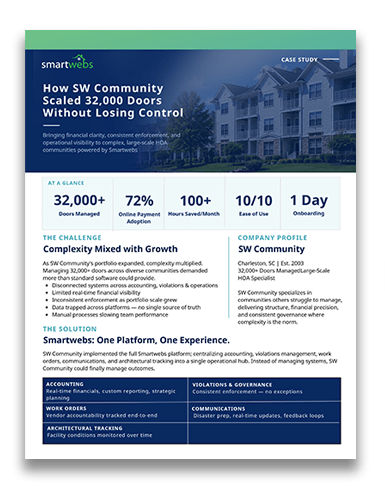
SW Community manages more than 32,000 doors using Smartwebs. The company reports 100+ hours saved each month, 72% online payment adoption, a 10/10 ease-of-use rating, and one-day onboarding.
Those numbers tell us something a feature checklist can’t.
The value isn’t simply that the software has accounting, violations, work orders, communications, and architectural tracking.
It’s what happens when those functions operate together.
Before Smartwebs, SW Community was working across disconnected accounting, violations, and operational systems. Manual processes consumed time, financial visibility was limited, and information was scattered across platforms. Smartwebs brought those functions into one operating environment.
That’s the kind of evidence management companies should ask every prospective technology provider to show.
Not simply:
What features do you have?
But:
What changed for customers after they started using them?
Read the SW Community case study
Seven Questions to Ask Before Your Next HOA Software Renewal
Before automatically renewing—or automatically deciding to leave—leadership should ask seven questions:
- What exactly changed in our pricing?
Understand whether the increase affects the core platform, modules, users, payments, integrations, services, or other parts of the relationship. - What additional value are we receiving?
Identify meaningful improvements in functionality, automation, support, security, integrations, reporting, or efficiency. - What else are we paying for because our current platform doesn’t provide it?
Look at third-party tools, integrations, reporting systems, manual processes, and other technology surrounding the primary platform. - How much work happens outside the system?
Spreadsheets and workarounds often reveal more about technology cost than the contract does. - Has service improved, remained consistent, or declined?
Technology value includes the relationship after the sale. - Can this platform support where we’re taking the company next?
Evaluate the business you’re becoming—not just the portfolio you’re managing today. - If we weren’t already using this software, would we buy it today at this price?
That last question may be the most revealing.
Existing technology has inertia.
Teams know it. Processes have been built around it. Data is already there. Changing systems requires effort.
But familiarity and value aren’t the same thing.
Don’t Just Compare Subscription Prices. Compare Operating Models.
If you decide to evaluate alternatives, don’t build the comparison entirely around price. 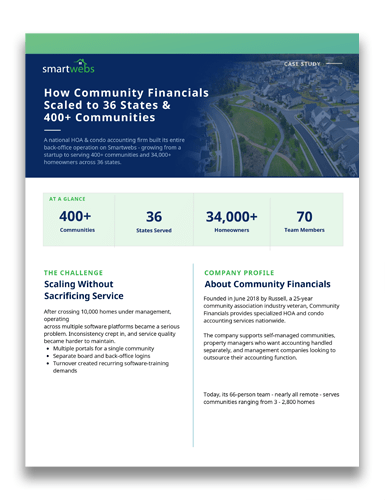
Compare what operating on each platform would actually look like.
How many systems will employees need?
How much manual work remains?
How are accounting and operations connected?
How does information move between departments?
What can be automated?
How does leadership access information?
What does reporting require?
How does the platform handle growth?
How does support work after implementation?
And what happens when your portfolio doubles?
Those questions reveal much more than a per-door number.
Community Financials offers a useful example.
The national HOA and condominium accounting company operates across approximately 400 communities, 30,000 homeowners, and 36 states using Smartwebs. As the organization expanded, managing employees across multiple software platforms had become increasingly difficult. Since adopting Smartwebs in 2022, Community Financials has migrated its customer base onto one platform while continuing its national growth.
That’s not simply a software story.
It’s an operating-model story.
Read the Community Financials case study
When Does Switching HOA Software Actually Make Sense?
Switching software is disruptive.
There is data to migrate.
Financial information to validate.
Employees to train.
Processes to reconsider.
Implementation takes time and attention.
Those costs are real, which is why a rate increase alone shouldn’t determine the decision.
But staying also has a cost.
If the gap between what you’re paying and what the platform enables your organization to accomplish keeps widening, avoiding a switch can eventually cost more than making one.
We’ve explored that side of the decision separately in:
What Is the Real Cost of Not Switching HOA Software?
The important thing is to evaluate both sides of the equation.
What will changing cost us?
And:
What will staying cost us?
A sound technology decision considers both.
Price Matters. Value Matters More.
No management company should ignore software costs.
But price without context tells you very little.
A less expensive system that creates more work may not be less expensive.
A more expensive platform that doesn’t deliver additional business value doesn’t become a better investment simply because it has more features.
The objective is alignment.
Your technology investment should align with the work your employees need to do, the service your clients expect, and the business you’re trying to build.
That’s where the software conversation becomes much more useful.
Not:
Which platform costs the least?
But:
Which platform gives our organization the strongest operating foundation for what we’re paying?
Smartwebs connects accounting, operations, governance, communications, reporting, workflows, and automation in one community association management environment.
One Login. One Unified Experience.
Ready to Look Beyond the Price Tag?
If you’re evaluating a software renewal—or wondering whether your current technology is still delivering enough value—bring us the processes your team deals with every day.
The spreadsheets.
The duplicate entry.
The manual reporting.
The disconnected workflows.
The additional systems.
The processes that take longer than they should.
We’ll show you how those same workflows operate inside Smartwebs so you can compare more than software pricing.
You can compare the way the business actually works.
See Smartwebs in action.
Frequently Asked Questions
Should I switch HOA software because my provider increased its prices?
Not necessarily. A price increase should prompt an evaluation of the value you’re receiving. Consider functionality, support, automation, integrations, efficiency, scalability, and total operating cost before deciding whether to stay or switch.
How should I compare HOA software pricing?
Compare more than the base subscription or per-door rate. Consider implementation, modules, integrations, payment-related costs, required third-party tools, support, internal labor, and the manual work needed to operate the platform.
What is the true cost of HOA management software?
The true cost includes both direct technology expenses and the operational costs associated with using it. Manual processes, duplicate entry, additional software, reporting work, administrative labor, and inefficient workflows can all increase the total cost.
When is an HOA software price increase justified?
A higher price may still be good value when it comes with meaningful improvements such as better functionality, security, automation, support, integrations, reporting, or measurable operational efficiency.
What are signs that HOA software is no longer providing enough value?
Potential signs include repeated price increases without meaningful improvements, declining support, growing dependence on spreadsheets and workarounds, additional third-party systems, limited reporting or visibility, and difficulty scaling operations as the portfolio grows.
What should management companies ask before renewing HOA software?
Ask what changed in the price, what additional value the company receives, what work still occurs outside the platform, whether service has improved, what other technology is required, and whether the platform can support the company’s future growth.
How do I know whether switching HOA software is worth the disruption?
Compare the cost and risk of migration against the ongoing cost of staying. Consider implementation and training alongside longer-term labor requirements, operational efficiency, scalability, support, reporting, and the business value each platform can deliver.
