


Streamline HOA Finances: How Modern HOA Accounting Software Improves Transparency and Saves Time
Updated September 2026
Managing an HOA’s finances isn’t difficult because associations lack financial data.
The challenge is making sure the right information is accurate, current, connected, and available to the people who need it.
Accounting teams need reliable records.
Community managers need answers.
Boards need timely financial information to make decisions.
Homeowners need confidence that assessments, payments, and balances are accurate.
And management-company leadership needs visibility across the communities it serves.
When financial information is scattered across systems, spreadsheets, portals, and manual processes, even straightforward questions can take too long to answer.
Modern HOA accounting software can change that.
By connecting billing, payments, payables, banking, reconciliation, budgets, and reporting, accounting technology can do more than make bookkeeping more efficient.
It can make financial information more useful—and financial operations more transparent.
What Does Financial Transparency Mean for an HOA?
Financial transparency doesn’t mean giving everyone access to every accounting record.
It means giving the right people reliable financial information when they need it, in a form they can understand.
For an HOA board, that might mean having current financial reports available before a meeting.
For a homeowner, it might mean seeing an accurate balance and payment history.
For a community manager, it might mean answering an appropriate financial question without waiting for someone in accounting to manually assemble the information.
For an accounting team, it means having accurate transactions, reconciliations, audit trails, and financial records that produce that information.
For management and company leadership, it means understanding financial operations across a growing portfolio.
Financial transparency begins with financial accuracy.
Technology simply makes that accuracy easier to maintain, access, and communicate.
Why HOA Financial Transparency Can Be Difficult
Community association accounting has a lot of moving pieces.
Assessments are billed.
Payments arrive.
Vendor invoices need approval.
Bank activity needs reconciliation.
Budgets need monitoring.
Delinquencies require attention.
Financial reports need preparation.
Boards have questions.
Homeowners have questions.
Now multiply that across dozens, hundreds, or even thousands of communities.
When those activities occur in disconnected systems, people often become the bridge between them.
Someone enters information twice.
Someone exports a report.
Someone maintains a spreadsheet.
Someone checks another system to verify a balance.
Someone emails accounting for an answer.
None of those activities seems particularly significant by itself.
Across an organization, however, they create delay, increase the opportunity for error, and make financial information harder to access.
That’s why modern HOA accounting technology isn’t simply about doing accounting faster.
It’s about creating a more reliable financial foundation for the organization.
The Real Cost of Delayed Financial Information
An accounting record can be accurate and still arrive too late to be useful.
Consider what happens when financial information isn’t readily available.
A community manager can’t answer a board member’s question without contacting accounting.
A board receives reports shortly before a meeting and has little time to review them.
A homeowner questions a balance because a recent payment hasn’t appeared.
Leadership needs someone to combine reports before it can understand what’s happening across the portfolio.
Accounting staff spends time responding to information requests instead of completing accounting work.
The problem isn’t necessarily that the organization lacks data.
The problem is the distance between the data and the person who needs it.
Modern accounting technology should help shorten that distance.
Better Billing Creates Better Financial Visibility
Financial transparency begins long before a financial report is generated.
It starts with the transaction.
Recurring assessments should be created consistently.
Payments should be posted accurately.
Adjustments should be documented.
Late fees and collection activity should follow established processes.
Homeowner account histories should be clear.
When billing requires excessive manual intervention, errors and delays can compound quickly.
Automation can help reduce that administrative burden by standardizing repetitive processes.
But automation itself isn’t the ultimate objective.
Automation saves work. Connected financial data creates visibility. Visibility creates confidence.
That’s the bigger opportunity.
What Boards Need From HOA Financial Technology
Boards have fiduciary responsibilities, but most board members aren’t professional accountants.
That makes the way financial information is presented especially important.
Board members need enough information to understand questions such as:
How are we performing against budget?
What is our current cash position?
What are we owed?
What expenses have been incurred?
Are there financial issues that require our attention?
How are reserve and operating funds performing?
Producing another report isn’t necessarily the answer.
The goal should be providing timely, understandable financial information that helps a board govern responsibly.
Technology can make that easier when transactions, budgets, banking, and reporting run on the same financial foundation.
What Homeowners Need From Financial Technology
Homeowners don’t need access to the association’s entire accounting system.
They do need confidence in the information that affects them.
That means understanding what they owe, seeing payments reflected accurately, accessing relevant account information, and having a reliable way to make payments.
When homeowner-facing information doesn’t match what management sees internally, trust can deteriorate quickly.
A homeowner may not know why two systems aren’t synchronized.
They simply know the balance looks wrong.
That is why financial transparency is also a homeowner experience issue.
Clear account information and convenient payment options don’t merely make accounting easier.
They reduce uncertainty.
What Community Managers Need
Community managers sit at the intersection of nearly everything happening in an association.
Boards ask them questions.
Homeowners ask them questions.
Vendors interact with them.
Accounting teams depend on them for information.
Yet managers shouldn’t have to become intermediaries between disconnected financial systems.
They need appropriate visibility into the financial information required to manage their communities effectively.
If answering a routine question requires searching multiple systems, emailing accounting, or waiting for a report to be rebuilt, the technology creates work rather than removing it.
A connected environment allows managers to spend less time finding information and more time using it.
What Accounting Teams Need
Financial transparency is impossible without accounting discipline.
Accounting teams need more than attractive dashboards.
They need:
- reliable general ledger activity
- accurate homeowner balances
- efficient receivables
- controlled accounts payable workflows
- dependable bank reconciliation
- budgeting
- financial reporting
- transaction histories
- appropriate audit trails
- consistent processes across communities
This is an important distinction.
Visibility without accuracy isn’t transparency. It’s just faster access to unreliable information.
The accounting foundation has to come first.
For a deeper look at how to evaluate those capabilities, read How to Choose the Best HOA Accounting Software for Your Management Company.
What Management-Company Leadership Needs
Financial visibility changes again at the executive level.
Leadership isn’t necessarily trying to investigate an individual homeowner transaction.
It needs to understand the organization.
Where are financial processes slowing down?
Where are reconciliations outstanding?
Where is accounting workload increasing?
Where are exceptions occurring?
Where does the team need attention?
And as the portfolio grows:
Can leadership maintain financial visibility without requiring more people to manually assemble it?
That is where financial technology becomes part of the management company’s operating model rather than simply an accounting tool.
Why Integration Matters to Financial Transparency
Accounting doesn’t operate independently from the rest of community management.
Homeowner information connects with assessments and payments.
Vendor activity connects with payables.
Community managers need financial information to answer questions.
Board communications often include financial information.
Documents, approvals, workflows, and reporting all touch different parts of the operation.
When these functions live in disconnected systems, employees have to move information between them.
That creates duplicate work and additional opportunities for information to become outdated or inconsistent.
Connected technology reduces those handoffs.
For Smartwebs, that means bringing accounting into the same environment as communications, violations, architectural requests, work orders, homeowner activity, reporting, and other community-management workflows.
One Login. One Unified Experience.
The benefit isn’t simply having more features under one login.
It’s creating fewer gaps between the people, processes, and information required to run a community.
Automation Saves Time. Visibility Creates Confidence.
Automation gets a lot of attention in HOA technology.
And for good reason.
Recurring charges can be automated.
Payments can be processed electronically.
Workflows can route invoices and approvals.
Reconciliation technology can reduce manual work.
Reports can be generated more efficiently.
Those improvements matter.
But the bigger question is:
What does the organization gain from the time automation saves?
If accounting teams spend less time on repetitive work, they have more capacity to address exceptions and higher-value financial tasks.
If managers can access appropriate information themselves, accounting receives fewer routine requests.
If boards receive timely reports, meetings can focus more on decisions and less on gathering information.
If homeowners have clearer account visibility, managers spend less time resolving confusion.
That’s why the value of automation isn’t simply speed.
It’s the capacity and confidence that speed creates.
What Financial Visibility Looks Like at Scale
Financial visibility becomes increasingly difficult as an organization grows.
One association is one set of financial records.
Hundreds of associations represent hundreds of budgets, bank accounts, reports, homeowner balances, vendor relationships, and financial workflows.
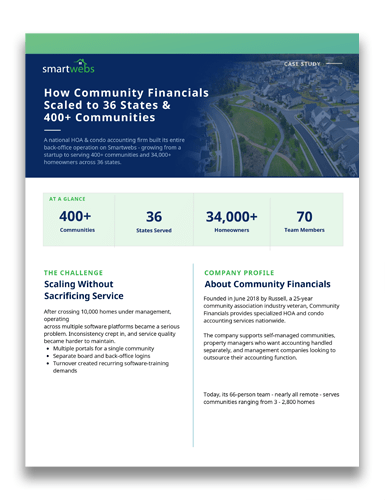
Community Financials provides a useful example.
The HOA and condominium accounting company built a national operation serving hundreds of communities across 36 states. As the company grew, operating across multiple software platforms created challenges with consistency and service quality.
Smartwebs became part of the company’s accounting infrastructure as it consolidated its client base onto a common platform and continued expanding.
The important lesson isn’t simply the size of the organization.
It’s that standardization and visibility become more important, not less, as complexity increases.
Read the Community Financials case study
From Disconnected Operations to Greater Visibility
SW Community provides another example from a different perspective.
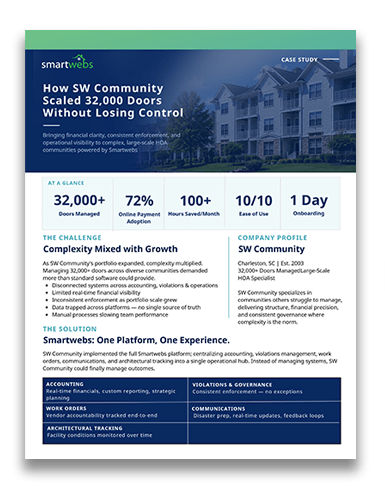
The company manages more than 32,000 doors, including large and complex communities.
Before Smartwebs, accounting, violations, and operational processes were disconnected. Financial visibility was limited, data was trapped across systems, and manual processes consumed employee time.
After bringing its operations into Smartwebs, the company reported 100+ hours saved each month, along with greater real-time financial visibility and a more centralized operating environment.
That’s significant because it illustrates the relationship between efficiency and visibility.
Saving time matters.
But being able to understand what’s happening across a complex portfolio matters too.
Read the SW Community case study
How Do You Know If Your HOA Has a Financial Visibility Problem?
Sometimes the clearest evidence isn’t in the accounting system.
It’s in the behavior surrounding it.
Ask:
Do board reports regularly require manual preparation outside the accounting platform?
Do managers frequently contact accounting for information they should reasonably be able to access?
Are spreadsheets being used to compensate for limitations in the primary system?
Do homeowners regularly question balances or payment status because information isn’t current?
Does leadership need someone to assemble information before it can understand financial operations?
Are employees entering the same information in more than one place?
If the answer to several of those questions is yes, the issue may not simply be accounting efficiency.
It may be financial visibility.
Better Financial Information Builds Trust
Trust in community association management isn’t created by technology alone.
It comes from accurate work, clear communication, consistent processes, and people doing what they say they’ll do.
But technology can either support that trust or make it harder to maintain.
When financial information is accurate and accessible:
Boards can make decisions with greater confidence.
Homeowners can better understand their accounts.
Managers can answer questions more efficiently.
Accounting teams spend less time resolving avoidable discrepancies.
Leadership gains greater visibility across the organization.
The result isn’t merely better bookkeeping.
It’s a stronger relationship between the people responsible for managing the community and the people depending on them.
Modern HOA Accounting Should Do More Than Balance the Books
The goal of modern HOA accounting technology isn’t to replace sound financial management.
It’s to support it.
That means making transactions easier to manage, reducing unnecessary manual work, connecting information across the operation, and helping the appropriate people access reliable financial information when they need it.
Because financial management isn’t just about numbers.
It’s about the decisions those numbers support.
The confidence they create.
And the trust they help maintain.
Smartwebs connects accounting with the broader community-management operation so teams can work from one connected environment.
One Login. One Unified Experience.
Ready for Better Financial Visibility?
If your accounting team is still rebuilding reports, reconciling information between systems, answering routine information requests, or relying on spreadsheets to fill the gaps, it may be time to look at the process differently.
See how Smartwebs connects accounting, operations, communications, reporting, and community-management workflows in one platform.
Schedule a Smartwebs Walkthrough →
Frequently Asked Questions About HOA Financial Transparency
What is HOA financial transparency?
HOA financial transparency means providing appropriate stakeholders with accurate, timely, and understandable financial information. It begins with reliable accounting records and includes giving boards, managers, homeowners, and management-company leadership appropriate access to the information they need.
How can HOA accounting software improve financial transparency?
HOA accounting software can improve financial transparency by keeping assessments, payments, expenses, banking activity, budgets, and reporting within a connected financial environment. This reduces delays and manual data entry while making current financial information easier to access.
Why is financial transparency important for HOA boards?
Board members rely on financial information to oversee budgets, expenses, cash, reserves, receivables, and other association obligations. Timely and understandable reporting helps boards make more informed decisions and fulfill their governance responsibilities.
How does financial transparency affect homeowners?
Clear balances, accurate payment histories, convenient payment options, and reliable account information can reduce confusion and give homeowners more confidence in how the association administers finances.
Does financial transparency mean homeowners should see every HOA financial record?
No. Transparency doesn’t mean unrestricted access to all accounting information. Access should be appropriate to the stakeholder and consistent with the association’s governance requirements, applicable law, privacy obligations, and financial controls.
How does automation improve HOA financial management?
Automation can reduce repetitive work associated with assessments, payments, invoice workflows, reconciliation, and reporting. The larger benefit is the capacity it creates for accounting and management teams to focus on exceptions, decisions, and higher-value work.
What should HOA management companies look for in accounting software?
Management companies should evaluate accounting accuracy, receivables, payables, reconciliation, reporting, banking, automation, audit trails, financial visibility, scalability, integrations, implementation, support, and how accounting connects with the broader community-management operation.
