
The Modern HOA Technology Stack: What Community Management Companies Need in 2026
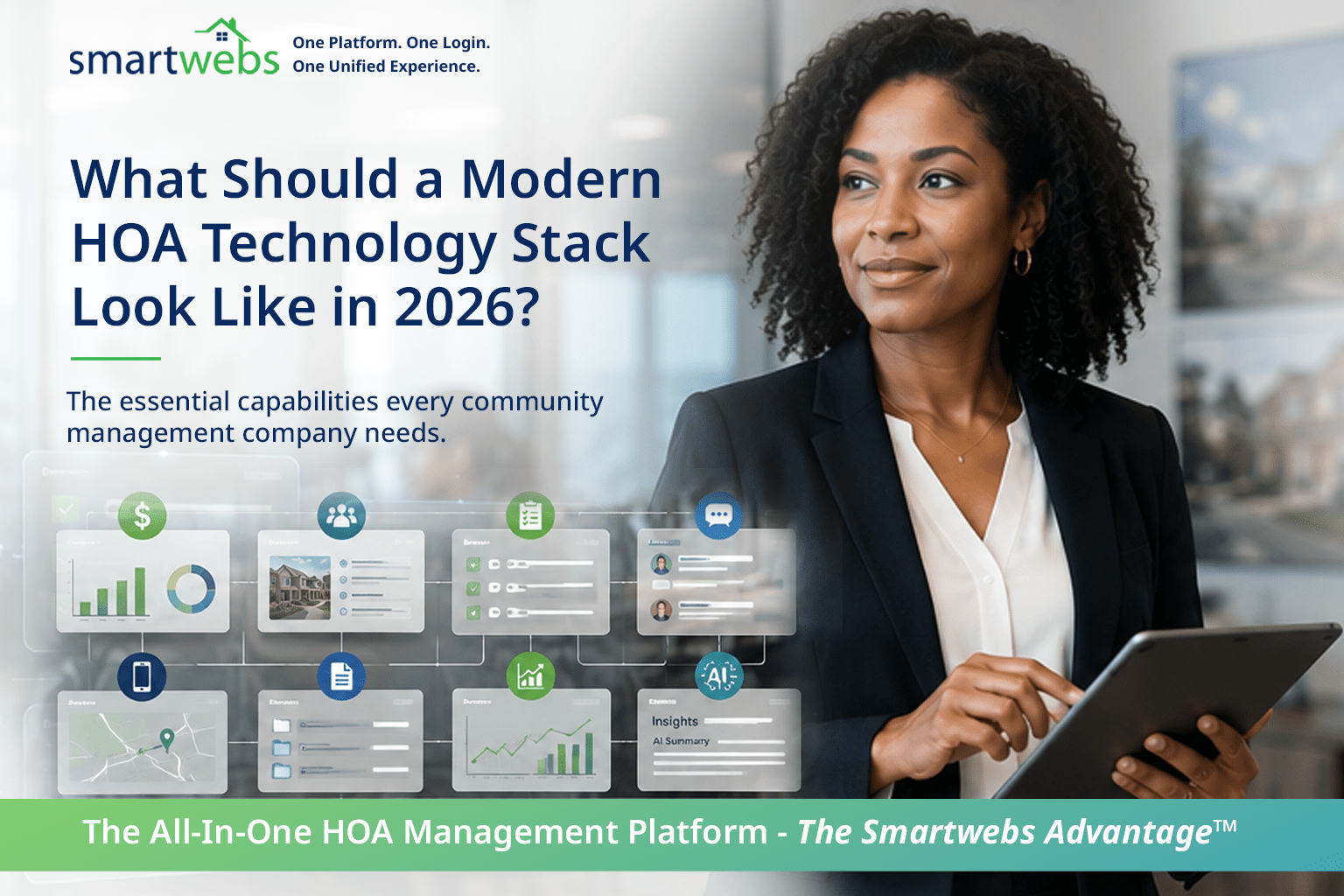
What Should a Modern HOA Technology Stack Look Like in 2026?
Community management technology has changed dramatically, but many management companies are still working with technology environments that were built one problem at a time.
An accounting system handled the books. Another application managed inspections. Email filled the communication gaps. Documents lived somewhere else. Spreadsheets became the workaround when systems couldn’t share information.
Each tool may have solved a problem. Together, they didn’t necessarily create a better way to manage communities.
That distinction matters more in 2026.
Management companies are being asked to operate more efficiently, provide faster responses to boards and residents, support field teams, maintain financial visibility, automate repetitive processes, and make better use of artificial intelligence.
The question is no longer simply, “What HOA software do we need?”
A better question is:
What should a modern HOA technology stack actually do?
What Is an HOA Technology Stack?
An HOA technology stack is the collection of systems a community management company uses to manage its financial, operational, administrative, and resident-facing responsibilities.
That can include accounting, violations, architectural requests, communications, portals, inspections, work orders, documents, reporting, payments, websites, mobile applications, and increasingly, artificial intelligence.
But a modern technology stack isn’t defined by how many applications an organization owns.
It’s defined by how well those capabilities work together.
For community management companies, the goal should be a technology environment in which information can flow across the organization without requiring employees to constantly move it themselves.
1. Financial Management Is Still the Foundation
Accounting remains one of the most important parts of community management technology.
Management companies need accurate financial information, reliable controls, and efficient processes for assessments, accounts payable, bank reconciliations, budgeting, reporting, delinquency management, and other financial responsibilities.
But modern financial management also needs context.
Leadership shouldn’t have to wait until the end of the month to understand what’s happening. Managers shouldn’t have to chase down accounting teams for every answer. Board members increasingly expect financial information to be accessible and understandable.
The technology stack should help turn financial data into useful information, not simply store transactions.
This is also where artificial intelligence is beginning to change expectations. AI can help identify anomalies, summarize complex financial information, surface trends, and reduce repetitive work in financial management.
2. Violations and ARC Need to Be Workflows, Not Administrative Burdens
Violations and architectural review requests are among the most common operational responsibilities in community management.
They can also become some of the most time-consuming.
A modern HOA technology stack should support the complete workflow, from identifying an issue or receiving a request through documentation, communication, review, follow-up, resolution, and reporting.
The keyword is workflow.
When different stages of the process occur in different systems, employees must manually connect them.
Technology should do more of that work.
3. Mobile Operations Should Connect the Field to the Office
Community management doesn’t happen exclusively behind a desk.
Managers conduct property drives, document violations, inspect common areas, meet with vendors, attend board meetings, and work throughout the communities they serve.
Mobile technology should therefore be part of the core technology environment, not an afterthought.
Information collected in the field should be useful immediately.
A manager shouldn’t have to return to the office, sort through photos and notes, remember which property each item belongs to, and then manually recreate the work inside another system.
This is an area where AI has enormous potential.
Smartwebs’ SAMi 360 Drive, for example, is designed around a simple idea:
Drives recorded. AI analyzed. Done.
The goal isn’t to add another application to a manager’s day. It’s to remove unnecessary steps from work they’re already doing.
4. Residents and Boards Need Self-Service Without Losing the Human Experience
Residents and board members expect access to information when they need it.
That doesn’t mean technology should replace the relationship between community managers and the people they serve.
It means technology should eliminate unnecessary friction.
A strong resident and board experience can provide convenient access to account information, documents, requests, community updates, payments, architectural activity, and other relevant information without requiring every interaction to begin with an email or phone call.
When routine information is easier to access, managers have more time for the situations that actually require their expertise.
That’s a better experience for everyone.
5. Communication Should Be Connected to the Work
Community management generates a tremendous amount of communication.
Residents ask questions. Boards request information. Managers send notices. Accounting teams need clarification. Vendors need updates.
When communication exists separately from the activity it relates to, context gets lost.
Employees search email histories. Information gets forwarded between departments. Someone has to remember what happened and where the conversation lives.
A modern HOA technology stack should connect communication to the underlying community, homeowner, request, violation, task, or financial activity whenever possible.
That creates continuity instead of another information silo.
6. Workflow Automation Should Remove Repetitive Work
Automation is sometimes treated as a futuristic capability.
In reality, some of the best automation is remarkably practical.
It can route a task to the right person.
Trigger the next step in a process.
Generate a reminder.
Update a status.
Reduce duplicate data entry.
Surface an exception that needs attention.
Those small improvements matter because community management is filled with repeatable processes.
The purpose of automation isn’t to remove people from community management. It’s to remove unnecessary administrative work from the people doing it.
7. Leadership Needs Operational Visibility
As management companies grow, leadership faces a different challenge.
They need to understand what’s happening across many communities, teams, and processes at once.
How many violations are open?
Where are workflows slowing down?
What financial issues require attention?
Which communities are generating unusual activity?
Where is staff time being consumed?
Traditional reporting often explains what already happened.
Modern operational intelligence should also help organizations understand what needs attention now.
That requires connected information and reporting that span the organization rather than living within individual applications.
8. AI Needs a Strong Technology Foundation
AI is quickly becoming part of nearly every technology conversation, including HOA management.
But adding an AI feature doesn’t automatically make a technology environment intelligent.
AI becomes more useful when it has access to relevant, connected information and a clear understanding of the workflow where that information matters.
That’s why the technology foundation is so important.
In community management, AI has the potential to help teams analyze financial information, find answers in governing documents, identify operational patterns, reduce repetitive fieldwork, summarize information, and surface insights that might otherwise require hours of manual review.
The opportunity isn’t simply to put AI inside HOA software.
It’s to use AI where it can meaningfully improve the work of managing communities.
From a Software Stack to an Intelligent Operating Environment
For years, organizations built technology stacks by adding applications.
Need accounting? Add accounting software.
Need inspections? Add another tool.
Need communications? Add another platform.
Need reporting? Build another spreadsheet.
The next evolution of HOA technology is different.
Instead of asking how many tools an organization needs, management companies can ask how many experiences their employees should have to navigate.
Ideally, fewer.
Financial information should connect with operations. Field activity should connect with the office. Communications should connect with the work. Reporting should provide visibility across the organization. AI should help teams understand and act on the information already being generated.
That’s no longer just a software stack.
It’s an operating environment.
What Should Management Companies Ask About Their Technology Stack?
Before adding another application, management companies should look at the technology they already have and ask:
How many systems does a manager need to log into during a typical day?
Where are employees entering the same information more than once?
Can field activity flow directly into operational workflows?
Can accounting, operations, communications, and reporting share information?
Can leadership see what is happening across the organization without assembling multiple reports?
Can residents and boards access routine information without always involving a manager?
Is AI reducing work, or is it simply another feature employees have to learn?
Those questions reveal much more about the health of a technology environment than the length of a software feature list.
The Future of HOA Technology Is Connected
The strongest HOA technology stack isn’t necessarily the one with the most applications.
It’s the one that makes managing communities simpler.
At Smartwebs, that philosophy is shaping how we continue to evolve our platform, from accounting and core community management operations to mobile workflows, reporting, resident experiences, and the expanding capabilities of SAMi AI.
The goal is not more technology for its own sake.
It’s fewer barriers between people, processes, and information.
One Platform. One Login. One Unified Experience.
Ready to Rethink Your HOA Technology Stack?
See how Smartwebs brings community management operations, financial management, automation, mobile workflows, and AI together in one connected platform.
Schedule a Smartwebs demo today and discover how one connected platform can transform the way your team manages HOA financial operations.
Schedule a Smartwebs Walkthrough →
Frequently Asked Questions
What is an HOA technology stack?
An HOA technology stack is the collection of systems used to manage community association finances, operations, communications, residents, boards, documents, field activities, reporting, and other management responsibilities. A modern stack focuses not only on individual capabilities but also on how well information and workflows connect across them.
What software does an HOA management company need?
Needs vary by organization, but management companies commonly require financial management, violations and ARC workflows, resident and board portals, communications, document management, mobile capabilities, reporting, workflow automation, and operational tools. Increasingly, AI is becoming part of that technology environment.
Why is integration important in HOA management software?
Connected systems reduce the need for duplicate data entry, manual information transfers, multiple logins, and disconnected reporting. Integration can help financial, operational, field, and resident information move more efficiently across the organization.
How is AI being used in HOA management?
AI can support HOA management by helping analyze financial information, retrieve information from governing documents, identify patterns, summarize complex information, assist with field operations, and automate repetitive processes. Its value depends on how effectively it is connected to actual community management workflows.
Is an all-in-one HOA platform better than multiple software tools?
There isn’t one model that’s right for every organization. Management companies should evaluate whether their technology supports efficient workflows, connected information, operational visibility, scalability, and a consistent user experience. The number of applications matters less than how effectively the technology works together.
