


What Is HOA Accounting Software? A Complete Guide for Community Associations
What Is HOA Accounting Software? A Complete Guide for Community Associations
Updated September 2026
HOA accounting isn’t quite the same as accounting for a traditional business.
Community associations collect assessments from homeowners, manage operating and reserve funds, pay vendors, reconcile bank accounts, track homeowner balances, prepare budgets, and provide financial information to boards—all while maintaining accurate records for each individual association.
For a management company overseeing dozens or hundreds of communities, that complexity multiplies quickly.
That’s where HOA accounting software comes in.
Quick Answer: What is HOA accounting software?
HOA accounting software is financial management technology designed specifically for homeowners associations and the companies that manage them. It helps manage association-specific financial processes including homeowner assessments, accounts receivable, accounts payable, bank reconciliation, budgeting, financial reporting, homeowner balances, collections, and transaction histories.
The best HOA accounting technology does more than record what happened financially.
It helps accounting teams maintain accurate records, gives managers and boards better financial visibility, reduces repetitive administrative work, and creates a financial foundation capable of supporting a growing portfolio.
Why Is HOA Accounting Different From Traditional Business Accounting?
At its core, accounting is still accounting.
Money comes in. Money goes out. Transactions are recorded. Accounts are reconciled. Budgets and financial statements help people understand financial performance.
But the environment surrounding HOA accounting is different.
A community association has homeowners paying assessments rather than traditional customers buying products. It has operating expenses, reserve funds, vendor obligations, budgets, bank accounts, homeowner balances, delinquencies, board oversight, and reporting requirements specific to the association.
A community association management company may be responsible for those processes across many separate associations at the same time.
That creates an important distinction.
A general accounting system is primarily designed to maintain financial records for a business.
HOA accounting software is designed around the financial relationships between associations, homeowners, boards, vendors, banks, and the management companies serving them.
That context matters.
What Does HOA Accounting Software Do?
HOA accounting software brings the core financial processes involved in managing a community association into a system designed around those workflows.
While capabilities vary by platform, the fundamental functions generally include the following.
Assessment Billing and Accounts Receivable
Associations depend on assessments to fund community operations.
HOA accounting software can help create recurring charges, maintain homeowner balances, record payments, manage adjustments and late fees, track delinquencies, and maintain account histories.
For management companies, automation becomes especially important because recurring processes multiply with every community added to the portfolio.
Accounts Payable
Associations regularly pay landscapers, maintenance providers, utilities, insurance providers, contractors, and other vendors.
Accounting software helps teams manage the financial workflow surrounding those obligations, including invoice processing, approvals, payments, vendor records, and transaction history.
The objective isn’t simply to pay bills electronically.
It’s to create a consistent, controlled process from invoice to payment.
Bank Reconciliation
Reconciliation helps confirm that the activity recorded in the accounting system aligns with the activity occurring in the association’s bank accounts.
HOA accounting software can make that process more efficient by bringing banking and accounting information closer together and helping accounting teams identify transactions or discrepancies requiring attention.
For a management company handling many associations, the efficiency of this process can have a significant impact on accounting workload.
Budgeting
Association budgets help boards understand anticipated income, expenses, and financial obligations.
Accounting technology can support budget creation and monitoring while helping teams compare actual financial activity against budgeted expectations.
That gives accounting teams, managers, and boards better visibility into how the association is performing throughout the year.
Financial Reporting
Financial reports turn accounting data into information people can use.
Depending on the association and platform, reporting may include balance sheets, income and expense statements, general ledgers, accounts receivable and payable reports, budget comparisons, cash information, and other financial statements.
Good reporting isn’t simply about producing more reports.
It’s about making reliable financial information easier for the appropriate people to understand and use.
Homeowner Account Management
Each homeowner has a financial relationship with the association.
Accounting software can maintain charges, payments, adjustments, balances, and account history associated with that relationship.
When homeowner account information is accurate and current, managers can answer questions more efficiently and homeowners can have greater confidence in the information they’re receiving.
Collections and Delinquency Management
Past-due assessments require consistent processes.
HOA accounting technology can help teams identify delinquent accounts, apply established charges or fees, document account activity, and support collection workflows.
The goal is consistency and visibility rather than relying on disconnected spreadsheets or manual tracking.
Audit Trails and Financial Controls
Financial systems should maintain a clear history of transactions and activity.
Permissions, approval processes, transaction histories, documentation, and audit trails help accounting teams maintain stronger controls and provide greater visibility into what happened, when it happened, and where appropriate, who took an action.
HOA Accounting Software vs. General Accounting Software
General accounting platforms can be excellent tools.
But they aren’t necessarily designed around community association management.
| General Accounting Software | HOA Accounting Software |
|---|---|
| Designed for general businesses | Designed around community associations |
| Standard customer receivables | Homeowner assessments and balances |
| General AP and vendor management | Association-specific AP and vendor workflows |
| Company-level budgeting | Individual community budgets |
| Standard bank reconciliation | Reconciliation across association bank relationships |
| General financial statements | Association and board financial reporting |
| Customer records | Homeowner financial histories |
| Usually one business environment | Can support many separate associations within a management portfolio |
The distinction becomes increasingly important as the number of communities being managed grows.
A self-managed association may have one set of books.
A community association management company may manage hundreds.
HOA Accounting Software vs. HOA Management Software
The terms are sometimes used interchangeably, but they don’t necessarily mean the same thing.
HOA accounting software primarily supports the financial operation of an association: assessments, receivables, payables, reconciliation, budgets, banking, homeowner balances, and financial reporting.
HOA management software can encompass a much broader range of operational functions, including violations, architectural requests, work orders, communications, resident portals, documents, tasks, vendors, reporting, facilities, and other community-management workflows.
Some technology platforms connect both.
That matters because accounting rarely operates entirely by itself.
Homeowners interact with financial information.
Managers answer financial questions.
Vendor activity can create payables.
Boards depend on financial reporting.
Leadership needs visibility across the portfolio.
When accounting and community operations exist in disconnected systems, employees often become the integration layer—moving information between platforms and filling gaps manually.
A connected platform can reduce those handoffs.
Who Uses HOA Accounting Software?
HOA accounting software serves several different users, and they don’t all need the same information.
Accounting teams use it to manage financial transactions, receivables, payables, reconciliation, reporting, budgets, and controls.
Community managers need appropriate financial visibility to manage communities and respond to board and homeowner questions.
Management-company leadership needs visibility across a portfolio to understand workload, financial operations, exceptions, and scalability.
Boards rely on accurate financial information to make decisions and fulfill their governance responsibilities.
Homeowners interact with appropriate portions of the financial system through activities such as paying assessments and viewing account information.
Self-managed associations may use HOA accounting technology to manage these processes without a professional management company.
The common requirement is the same:
Accurate financial information needs to reach the appropriate person without creating unnecessary work along the way.
What Are the Benefits of HOA Accounting Software?
The value of HOA accounting software isn’t simply that it moves bookkeeping onto a computer.
Modern technology can improve the financial operation in several ways.
Less repetitive work. Automation can reduce manual effort surrounding recurring financial processes.
Greater consistency. Standardized workflows help teams perform routine accounting processes more consistently across communities.
Better accuracy. Reducing unnecessary manual entry can reduce opportunities for avoidable errors.
Greater financial visibility. Connected financial information makes it easier for accounting teams, managers, boards, and leadership to access the information appropriate to them.
Improved homeowner experience. Clear balances, payment options, and current account information can reduce confusion and routine questions.
Stronger operational capacity. Efficient systems can help management companies handle greater transaction volume without requiring administrative work to increase at exactly the same rate.
More scalable operations. Standardized financial processes become increasingly valuable as a management company’s portfolio expands.
Current Vantaca accounting content similarly emphasizes that modern HOA accounting has moved beyond bookkeeping toward accuracy, controls, visibility, risk reduction, and scalability.
For a deeper look at the visibility side of the equation, read Streamline HOA Finances: How Modern HOA Accounting Software Improves Transparency and Saves Time.
What Features Should HOA Accounting Software Include?
Not every organization needs exactly the same configuration, but core capabilities typically deserve close evaluation.
Look at accounts receivable and assessment billing, accounts payable, bank reconciliation, budgeting, financial reporting, homeowner account histories, collections workflows, banking connectivity, payment processing, audit trails, permissions, automation, integrations, security, portfolio-level reporting, implementation, and data migration.
But a feature existing doesn’t tell you whether it works well.
That’s why buyers should move beyond:
“Does the software have bank reconciliation?”
and ask:
“Show us how your bank reconciliation process actually works.”
Instead of:
“Do you have accounts payable?”
ask:
“Show us how an invoice moves from receipt through approval and payment.”
The distinction is important.
Feature lists tell you what software claims to have. Workflows show you how your team will actually work.
For the full evaluation process, see How to Choose the Best HOA Accounting Software for Your Management Company.
How Does HOA Accounting Software Improve Financial Transparency?
Financial transparency doesn’t mean giving everyone unrestricted access to accounting information.
It means providing appropriate stakeholders with accurate, timely, understandable financial information.
For boards, that can mean receiving current financial reports with enough time to review them before making decisions.
For managers, it can mean accessing appropriate financial information without repeatedly asking accounting to build a report.
For homeowners, it can mean seeing accurate balances and payment histories.
For leadership, it can mean understanding financial operations across a portfolio.
And for accounting teams, transparency begins with accurate records, reliable processes, controls, and reconciliation.
CINC’s current integrated-accounting content similarly emphasizes bringing financial information together so managers can access a more complete financial picture and produce reports more efficiently.
The important principle is:
Visibility without accuracy isn’t financial transparency.
Accuracy has to come first.
How Does HOA Accounting Software Help a Management Company Scale?
This is where HOA accounting software becomes more than a bookkeeping tool.
Imagine one community.
It has a budget, bank accounts, homeowner balances, assessments, payments, invoices, vendors, reconciliations, reports, and a board.
Now multiply those financial relationships across 50 communities.
Then 100.
Then 400.
Growth creates more transactions, more bank activity, more invoices, more payments, more reporting, more homeowner questions, and more exceptions.
If every additional community requires a proportional increase in manual accounting work, the technology isn’t really helping the organization scale.
Scalable HOA accounting technology should help standardize processes, automate appropriate repetitive work, maintain financial controls, and preserve visibility as transaction volume grows.
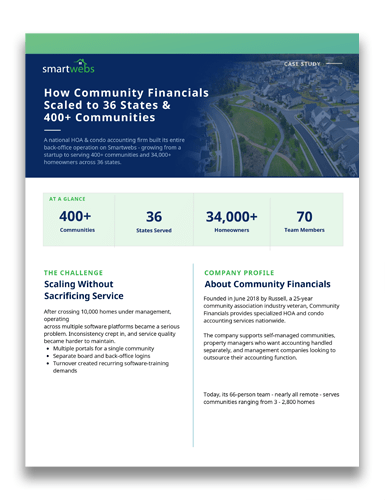
Community Financials demonstrates what that can look like at substantial scale.
The national HOA and condominium accounting firm operates across approximately 400 communities and 30,000 homeowners in 36 states. After passing 10,000 homes, managing staff across multiple software platforms had become increasingly difficult. Since adopting Smartwebs in 2022, the company has migrated its customer base onto the platform while continuing to grow nationally.
That’s not simply an accounting-software story.
It’s an example of why the underlying operating model matters as an organization grows.
Read the Community Financials case study
Can HOA Accounting Software Actually Save Time?
Yes, but “saves time” should be more than a marketing claim.
The better question is:
Where does it save time, and how much?
Look for reduced manual entry, more efficient invoice workflows, easier reconciliation, fewer reporting workarounds, faster access to information, fewer disconnected systems, and less time spent moving data between them.
And ask prospective providers for evidence.
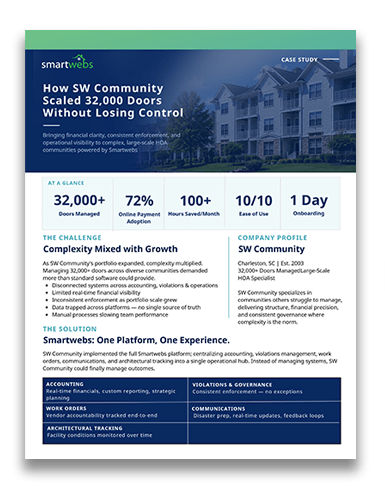
SW Community provides one Smartwebs example.
The large-scale management company manages more than 32,000 doors. Before Smartwebs, its accounting, violations, and operational systems were disconnected, financial visibility was limited, and manual processes slowed the team down.
After centralizing those functions on Smartwebs, SW Community reports 100+ hours saved per month, 72% online payment adoption, greater real-time financial visibility, and a more centralized operating environment.
That’s considerably more useful to a buyer than simply being told software is “efficient.”
Read the SW Community case study
What Does HOA Accounting Software Cost?
There isn’t one standard pricing model for HOA accounting software.
Pricing can vary based on factors such as the number of homes or units, associations, users, modules, functionality, implementation requirements, integrations, payment services, and the provider’s broader business model.
That’s why comparing two platforms solely on their advertised subscription price can be misleading.
The more useful question is:
What does this technology cost our organization to operate?
Consider the software price alongside implementation, integrations, required third-party tools, payment-related costs, support, internal labor, manual processes, and the additional systems employees need to accomplish their work.
A platform with a lower subscription price can still create a higher operating cost if employees spend significantly more time working around it.
Conversely, a more expensive platform isn’t automatically a better investment.
Price matters. Value matters more.
For a deeper evaluation of that question, read Your HOA Software Costs More. Are You Getting More Value?
When Should an HOA or Management Company Consider New Accounting Software?
You don’t need to replace accounting software simply because something newer exists.
The better question is whether the current system still supports the organization effectively.
Potential warning signs include growing dependence on spreadsheets, duplicate data entry, manual reconciliation, difficulty producing reports, disconnected systems, limited financial visibility, increasing administrative workload, or technology that becomes harder to manage as the portfolio grows.
For management companies, another useful question is:
If our portfolio doubled, what would happen to the accounting workload?
If the answer is that people, manual processes, spreadsheets, and administrative complexity would need to double too, the organization may have a scalability problem rather than simply an accounting problem.
That doesn’t automatically mean switching is the answer.
But it does mean the current operating model deserves evaluation.
For more on that decision, read What Is the Real Cost of Not Switching HOA Software?
How Should You Evaluate HOA Accounting Software?
Start with your actual workflows.
Don’t begin with a vendor’s feature checklist.
Bring the processes your team performs every day:
Receivables.
Payables.
Reconciliation.
Financial reporting.
Budgeting.
Collections.
Homeowner account questions.
Banking.
Portfolio reporting.
Then ask the provider to show you how those processes work inside the system.
Evaluate not only whether the functionality exists, but how many steps it requires, where manual intervention remains, what information is available to different users, how exceptions are handled, and what happens as your organization grows.
Current HOA software buyers face many platforms making similar promises about efficiency and growth; Vantaca’s 2026 buyer guidance likewise argues that buyers need to look beyond surface-level feature comparisons and understand the operating model behind the technology.
The software should fit the way your organization needs to work—not force your organization to build increasingly complicated processes around the software.
HOA Accounting With Smartwebs
Smartwebs approaches accounting as part of the broader community-management operation.
Accounting connects with the people and processes surrounding it—community managers, homeowners, boards, vendors, communications, reporting, workflows, and operational activity.
Bringing those functions into a connected environment reduces the need for employees to move between disconnected systems simply to understand what’s happening in a community.
For organizations managing complex portfolios, that connection becomes increasingly valuable as they grow.
One Login. One Unified Experience.
The objective isn’t simply to give your accounting team another piece of software.
It’s to give the organization a stronger financial and operational foundation.
See How HOA Accounting Works Inside Smartwebs
If you’re evaluating HOA accounting technology, bring us the workflows that matter most to your team.
Receivables. Payables. Reconciliation. Reporting. Banking. Collections. Portfolio visibility.
We’ll show you how those workflows work inside Smartwebs so you can evaluate the platform against how your organization actually works.
See Smartwebs in action.
Frequently Asked Questions
What is HOA accounting software?
HOA accounting software is financial management technology designed for homeowners associations and the companies that manage them. It supports association-specific processes such as homeowner assessments, accounts receivable, accounts payable, bank reconciliation, budgeting, reporting, homeowner balances, collections, and transaction histories.
How is HOA accounting software different from general accounting software?
General accounting software is designed for standard business accounting. HOA accounting software is designed around the financial relationships and workflows of community associations, including homeowner assessments, association budgets, board reporting, community bank accounts, and potentially multiple associations within one management portfolio.
Is HOA accounting software the same as HOA management software?
Not necessarily. HOA accounting software focuses primarily on financial operations. HOA management software may also include violations, architectural requests, work orders, communications, resident portals, documents, reporting, and other operational workflows. Some platforms combine both.
Who uses HOA accounting software?
Professional management companies, accounting teams, community managers, self-managed associations, and other professionals responsible for association finances may use HOA accounting software. Boards and homeowners may also access relevant financial information produced through the system.
What features should HOA accounting software have?
Core capabilities may include assessment billing, accounts receivable, accounts payable, bank reconciliation, budgeting, financial reporting, homeowner account histories, collections workflows, payment processing, banking connectivity, permissions, audit trails, automation, and integrations.
Can HOA accounting software manage multiple associations?
Platforms designed for professional community association management can support financial operations across multiple associations. Management companies should evaluate how effectively a system maintains separation, consistency, reporting, controls, and visibility as the portfolio grows.
Does HOA accounting software handle homeowner payments?
Many HOA accounting platforms support homeowner payment processing and account tracking. Exact payment methods, processing models, fees, integrations, and capabilities vary by provider and should be reviewed during evaluation.
Can HOA accounting software help with bank reconciliation?
Yes. Bank reconciliation is a core function of HOA accounting technology. Buyers should evaluate not merely whether reconciliation is offered but how transactions are matched, exceptions are handled, and accounting teams manage reconciliation across multiple associations.
How much does HOA accounting software cost?
Pricing varies by provider and may depend on homes or units, associations, users, functionality, modules, implementation, integrations, payments, and other services. Buyers should consider total operating cost rather than comparing subscription prices alone.
Can you switch HOA accounting software without losing historical data?
Historical data can often be migrated, but the amount, format, process, and validation vary by provider. Before switching, organizations should establish exactly which financial data will move, how it will be validated, what historical information will remain accessible, and what will happen before the new system goes live.
